
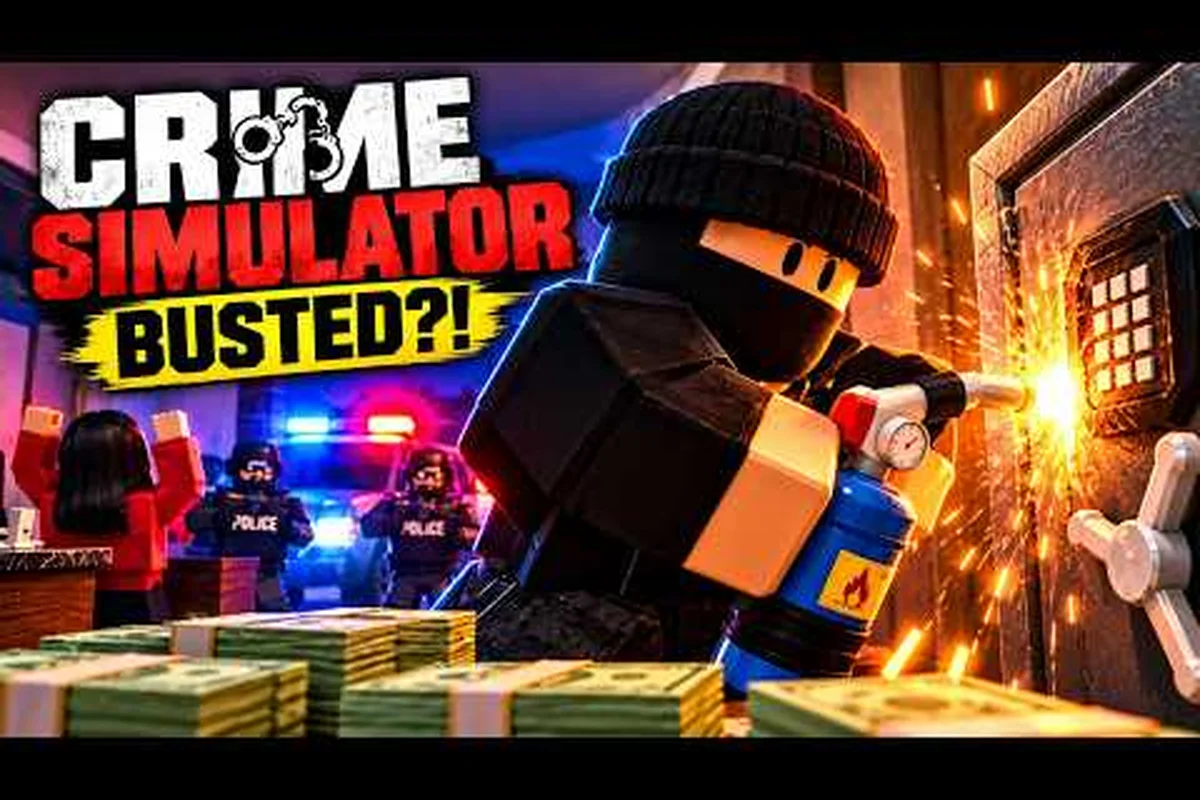
Criminal Simulator multiplayer mechanics turn a Roblox night heist into a coordinated crew operation where every player changes the plan. Knowing the official game page, police AI, K9 behavior, and difficulty scaling helps teams steal cash, escape pursuit, and sell loot before the deadline.
How Crews Coordinate in a Night Heist
The official Criminal Simulator game page describes an alpha night-heist experience built around crews of one to four players. The objective is straightforward at first: rob the city at night, avoid residents and police, escape K9 units, and sell stolen goods before the clock expires. Multiplayer adds a second layer: your crew must divide movement, carry capacity, distractions, and escape decisions without slowing everyone down.
Understanding criminal simulator multiplayer mechanics matters because solo success does not automatically translate into a reliable team run. A player who waits at the exit, follows the same route every time, or ignores the sale deadline can undo an otherwise successful robbery. Strong crews communicate in short, specific callouts and assign responsibilities before the first objective is reached.
| Core objective | Solo implication | Multiplayer implication |
|---|---|---|
| Enter the city | Choose one approach | Use separate entry points when possible |
| Steal valuables | Balance speed and weight | Let faster players secure priority loot |
| Avoid residents | Reduce visible noise | Keep teammates spread across sightlines |
| Escape police | Plan a personal route | Coordinate decoys and regroup points |
| Sell loot | Return before the deadline | Assign one seller while others cover |
The shared night-heist loop
A successful criminal simulator gameplay run normally follows a clear sequence: scout the target, steal valuables, respond to detection, reach safety, and sell the loot. Multiplayer does not change that basic loop, but it adds parallel decisions. Two players can enter a location through separate doors, collect different valuables, and still regroup before the police response becomes overwhelming.
The deadline makes every extra second count. A slow loading process, missed collectible, or premature chase can consume the margin needed for the sale. Crews should therefore decide whether the objective is quick extraction, maximum loot, or safe completion before entering the target. Trying to optimize all three at once usually produces the least consistent results.
What the alpha version currently establishes
As of October 31, 2026, the official page identifies Criminal Simulator as an alpha experience developed by Pigged Out Studios. It also reports support for crews of one to four players, which makes flexible crew sizes central to the experience. Community and official-page data should still be treated carefully because balance and AI behavior may change during alpha development.
The game’s current presentation has also attracted attention: the official page showed more than 5.4 million visits, 92,500 favorites, and roughly 24,800 concurrent players at the time of verification. These figures show strong interest, although they do not prove that every available crew composition performs equally well.
Crew Roles That Improve Criminal Simulator Multiplayer Coordination
Crew roles work best when they describe immediate tasks rather than fixed character classes. A player can be the point carrier, window watcher, distraction maker, route planner, or escape marshal, and those roles can change as the situation develops. Flexible assignments help because the same crew may need to split up during entry, regroup while stealing, and reorganize after detection.
A useful planning system is to name one player for each immediate responsibility. Do not ask everyone to watch the same doorway or carry everything. Overlapping jobs create confusion, especially when police AI redirects the group toward a new route.
| Crew role | Primary task | Best moment to lead | Failure risk |
|---|---|---|---|
| Point carrier | Enter first and secure priority loot | Initial entry | Fast detection |
| Rear guard | Watch the route behind the team | Room clearing | Late pursuit warning |
| Loot carrier | Protect high-value valuables | Collection phase | Heavy movement penalty |
| Distraction player | Draw attention away from teammates | Mid-rob | Overextended alone |
| Route planner | Track escape options and regroup points | After alert escalation | Wrong assumption about police |
| Seller | Secure and sell loot safely | Final approach | Missed deadline |
Assigning roles before entry
The best time to assign roles is before the first door opens. Start with the route planner identifying the target, the likely exit, and the fallback location. Then assign the point carrier to the first valuable objective and the rear guard to watch behind the team. A third player can protect the seller or collect secondary loot, while the fourth creates a distraction when necessary.
This arrangement reduces the sort of improvised movement that makes police encounters difficult. Instead of reacting individually to a patrol, the crew can respond as a unit. The rear guard alerts everyone, the route planner redirects the group, the point carrier chooses between escape and one last grab, and the seller confirms the remaining time.
Changing roles without confusion
Roles should not be treated as permanent jobs. If the point carrier is detected, another player may need to create space. If the seller has no loot, the crew should assign a backup carrier early. Clear callouts matter more than formal titles, especially in a fast Roblox session where voice communication may not always be available.
The broader criminal simulator gameplay loop also supports flexible crews because objectives can produce loot in different locations. A team that always uses the same route may overlook safer alternatives. Players should identify at least two entry options, one immediate escape point, and one longer-term fallback before committing to the target.
Police AI, Detection, and Crew Responses
The criminal simulator police ai creates escalating pressure rather than a single stationary obstacle. Police presence can become more dangerous as the crew spends more time inside the target, steals valuable loot, or exposes itself in public areas. The crew must therefore interpret warning signs and decide whether to continue, conceal valuables, redirect its route, or run.
Police behavior is easier to manage when the crew separates awareness, pursuit, and arrest or damage pressure. A patrolling officer may notice something before committing to a chase. Once the officer starts pursuing, the crew gains time by changing direction, breaking line of sight, and using the map’s routes. The mistake is assuming that every patrol follows the same path or reacts to every sound identically.
| Warning sign | Likely interpretation | Best crew response |
|---|---|---|
| Officer changes direction | Possible detection or suspicious sound | Pause looting and observe |
| Persistent pursuit | Player is actively targeted | Split briefly and regroup off-route |
| Nearby K9 unit | Scent tracking may be active | Avoid shortcuts and crowded cover |
| Route ahead is blocked | Police are anticipating escape | Use the planned alternate path |
| Sale timer is low | Success requires immediate extraction | Assign one seller and secure the rest |
Recognizing escalation
The official game page frames police and residents as part of the escape challenge, while community guides describe careful movement and timely selling as central to progression. Because exact detection values are not clearly published, players should rely on visible changes in behavior rather than assume a fixed reaction time.
A practical escalation rule is to move only when the crew has a confirmed route. Stop near corners, listen for movement, and avoid crossing an open area immediately after a patrol changes direction. If pursuit begins, the crew should not scatter without a destination. One player may draw attention, but the others need a reachable regroup point.
For a deeper look at evading patrols, the Criminal Simulator hiding and pursuit guide explains how to use hiding spaces and alternate routes. The essential crew principle remains the same: every diversion should buy another player enough time to reach safety, not merely delay the same officer for a few seconds.
Why one player’s mistakes affect everyone
AI pressure is not isolated. If a player triggers pursuit inside a narrow street, nearby police can converge on the crew. If a player sprints through a quiet patrol zone with a suspicious item, other targets may become harder. The best criminal simulator multiplayer mechanics revolve around shared awareness: one person watches the route, one confirms the callout, and the group acts on confirmed information.
Good communication should be concise. “Left,” “move now,” and “seller has the bag” are useful because they describe actions. Extended explanations can become noise, while silence during a patrol change can be just as damaging. If one player cannot see the danger, they should follow the last confirmed route rather than create a new one.
Dog AI and K9 Mechanics During Night Heists
The criminal simulator dog ai adds a different kind of pressure from ordinary police patrols. The official game page identifies police K9s as part of the night-heist escape challenge, which means a crew needs to treat canine units as dedicated tracking threats. A dog may remain relevant after a player changes direction, so simply running in a circle is not a dependable escape plan.
Community observations about Roblox night heists commonly associate dogs with scent, pursuit, and restricted hiding options. These details may vary by version, especially while the game remains in alpha. The safe approach is to avoid assuming that every container, wall, or rooftop defeats canine tracking equally well.
| Dog-related factor | Practical meaning | Crew decision |
|---|---|---|
| Dog joins a pursuit | A player may be actively tracked | Break contact and alter route |
| Dog stays near an exit | That exit is no longer a safe plan | Use a less obvious route |
| Dog reacts to carried loot | High-value cargo may increase risk | Assign a clean runner |
| Dog appears near regroup point | The crew was predictable | Choose a new meeting location |
| Dog is separated from handler | Temporary opening, not a free pass | Leave quickly without noise |
The difference between hiding and escaping
The criminal simulator k9 mechanics make hiding decisions more demanding because hiding may not end the threat if the dog is already tracking. A crew that simply stops behind the first available object can create a standoff: nobody moves, the sale timer continues, and officers regroup. Movement must create distance while retaining a plausible destination.
Use clean routes rather than repeated loops. Cross a street only when the patrol has passed, use cover to change direction, and make sure the route does not pass the dog again. If one member of the crew is being followed, another player should lead the group away before the tracker closes the gap.
Planning for K9 pressure by crew size
In a duo, one player can create a diversion while the other moves with the loot. In a trio, the third player can watch for dogs and correct the route. A four-person crew has more flexibility, but it also creates more noise and more chances for one player to be identified. The best criminal simulator difficulty choice is therefore based on coordination quality, not simply the number of avatars in the lobby.
A less experienced crew should choose objectives with multiple exits and avoid routes that force everyone through one dog-controlled choke point. Experienced crews can use controlled distractions, but they still need a timing plan. Community reports often emphasize that careless speed creates more pursuit than slower movement, especially when loot is visible.
Difficulty Scaling and Heist Planning
The criminal simulator difficulty affects planning through attention, reaction speed, and the cost of mistakes. The official description mentions sneaking past residents, outrunning police and K9 dogs, and selling loot before the deadline. Together, these systems make timing a central resource: the crew must balance exploration, looting, and extraction without losing the sale window.
Because the game is still labeled alpha, difficulty values and AI tuning may shift. Treat the table below as a practical team framework rather than a list of hidden multipliers. It describes how to change decisions as the night becomes more urgent, not a claim that each band has a fixed numerical setting.
| Planning state | Crew behavior | Best objective choice |
|---|---|---|
| Early exploration | Map routes and test patrols | Lower-risk locations with clear exits |
| Active theft | Split briefly and collect priority loot | Limited targets with short interior routes |
| Heavy pursuit | Abandon optional loot and extract | Open routes or alternate exits |
| Sale window closing | Protect the seller and clear a path | Direct approach to a sale point |
| After failed sale plan | Recover remaining loot calmly | Secondary sale or safer regroup |
Preparing before the night begins
A disciplined crew can reduce criminal simulator difficulty without relying on rare equipment or hidden exploits. Choose a target based on exit count, not the value of its visible loot. Review which teammates can carry weight, which player has the clearest route sense, and who will remain with the seller during extraction.
The official page’s support for crews of one to four players gives teams flexibility, but flexibility only helps when the group can coordinate. Players new to the role of point carrier should practice entering, identifying the first target, and withdrawing without carrying excessive loot. More experienced players can focus on distractions and route control.
For a broader view of the night cycle, the Criminal Simulator gameplay mechanics overview explains how objectives, stealth, and police responses connect. Multiplayer crews should treat those systems as one shared operation rather than as individual minigames.
Assigning a clear abort threshold
Every crew needs an abort condition. It could be a heavily occupied exit, multiple dogs entering the target, an unexpectedly long indoor route, or a sale timer that no longer supports the loot on hand. Once the threshold is crossed, the point carrier stops collecting and the route planner redirects everyone.
| Trigger | Decision | Reason |
|---|---|---|
| Primary exit is watched | Use fallback route | Avoid predictable corridor |
| Two or more K9s appear | Abort optional loot | Limit tracking pressure |
| Crew splits beyond recovery range | Pause and regroup | Prevent isolated arrests |
| Timer cannot cover sale travel | Leave immediately | Protect partial success |
| Seller has no carried loot | Assign backup carrier | Maintain escape objective |
Protect partial success
A night heist does not need to end with a perfect score to be worthwhile. Crews can leave with a smaller haul, sell it, and use the result to fund another attempt. This mindset reduces reckless behavior because players no longer feel forced to grab every valuable after detection begins.
The best criminal simulator gameplay strategy is to preserve the option to finish. That means one player tracks the timer, one protects the seller, and the others accept that speed and loot have limits. Teams that assign these responsibilities dynamically usually react better when police AI or a K9 forces a route change.
Practical Strategies for Consistent Crew Runs
Consistency comes from repeatable preparation, not memorizing one route. Each run should begin with a short briefing that covers the target, entry order, primary exit, fallback exit, sale point, and abort condition. The briefing takes less than a minute, while the cost of ambiguity can be an entire failed heist.
A good callout vocabulary uses roles rather than personal names. Calling out “seller,” “point,” or “rear” remains clear even when players change character skins or join at different times. For non-voice groups, short text messages or pings work better than long explanations. The crew should confirm only decisions that affect everyone.
| Preparation step | Team result | Time saved later |
|---|---|---|
| Name the point carrier | Clear first objective | Faster room entry |
| Mark primary and fallback exits | Less hesitation during pursuit | Faster route changes |
| Assign a seller | Protected sale objective | Reduced end-of-run confusion |
| Set an abort threshold | Consistent withdrawal decisions | Fewer unnecessary captures |
| Limit optional loot | Shorter escape route | Earlier and safer sale |
Run short reconnaissance before committing
The point carrier can enter first while the rest of the crew waits outside or approaches from another direction. This reveals residents, patrol pressure, and the route to the first valuables without committing every teammate. The drawback is that the reconnaissance player must have a safe retreat if detected.
The Criminal Simulator police guide provides additional context for patrol behavior and stealth preparation. In multiplayer, reconnaissance is most valuable when its findings are reported immediately, especially locations where residents or officers create overlapping sightlines.
Keep the crew recoverable
A crew should remain within support distance unless a deliberate diversion is happening. This does not mean stacking everyone in the same doorway; it means keeping the next regroup point within a manageable distance. If the loot carrier becomes isolated, the team should pause the plan rather than create a second rescue route.
This structure supports better criminal simulator multiplayer mechanics because every player understands what must remain protected. The seller and highest-value loot are priorities, but the crew should not sacrifice a teammate merely to preserve cargo. A living teammate can still assist with the sale and the next run.
Review failures without blaming one player
After a failed heist, identify the decision that created the largest time or exposure cost. Was the group too slow inside? Did the rear guard fail to report a route change? Did the point carrier take an optional objective? Was the crew too concentrated for a dog pursuit? Assigning the problem to a mechanic produces a better next run than assigning it to a person.
Community guides can help identify recurring early-game patterns, including the emphasis on money, upgrades, and efficient movement in the Blueburry Criminal Simulator community guide. Treat those observations as current player experience rather than developer-confirmed rules, especially as the alpha receives updates.
Frequently Asked Questions
How many players can join a Criminal Simulator crew?
The official Criminal Simulator game page supports crews of one to four players, allowing solo attempts or teams of two, three, or four. Smaller crews benefit from simple role assignment, while larger crews have more room for a point carrier, rear guard, distraction player, and dedicated seller. A good crew should still avoid assigning multiple players to the same immediate task.
How do police AI and dog AI differ in a Roblox night heist?
Police AI appears to create escalating pursuit pressure as the crew steals, stays exposed, or remains within a patrol area. Dog AI adds a tracking-focused threat that can make a previously safe exit or hiding place unreliable. Because exact detection rules may change during alpha development, players should watch behavior rather than assume every obstacle ends a pursuit equally well.
Does carrying more loot make a crew easier to catch?
More valuable cargo can make escape less forgiving because movement becomes less flexible and each extra item may extend the route to the sale point. The exact impact depends on the current game version and player state, so crews should protect only the loot they can extract before the deadline. Abandoning optional valuables can be a better decision than risking the entire haul.
Should a crew split up immediately after entering a building?
Only when every subgroup has a clear purpose and a confirmed retreat route. Useful splits include a point carrier taking the primary objective while a rear guard watches the entrance, or one player creating a controlled diversion while others move the loot. Without those assignments, early splitting often creates isolated players who cannot regroup when police or a K9 redirects the chase.
What is the best way to handle rising criminal simulator difficulty?
Reduce optional objectives, preserve a clear seller, and leave earlier when the abort threshold is reached. Difficulty rises through pursuit pressure, detection, and the sale deadline, so greed can compound several losses at once. Strong crews maintain two viable exit routes and assign a specific player to watch pursuit changes rather than relying on every teammate noticing the danger independently.