
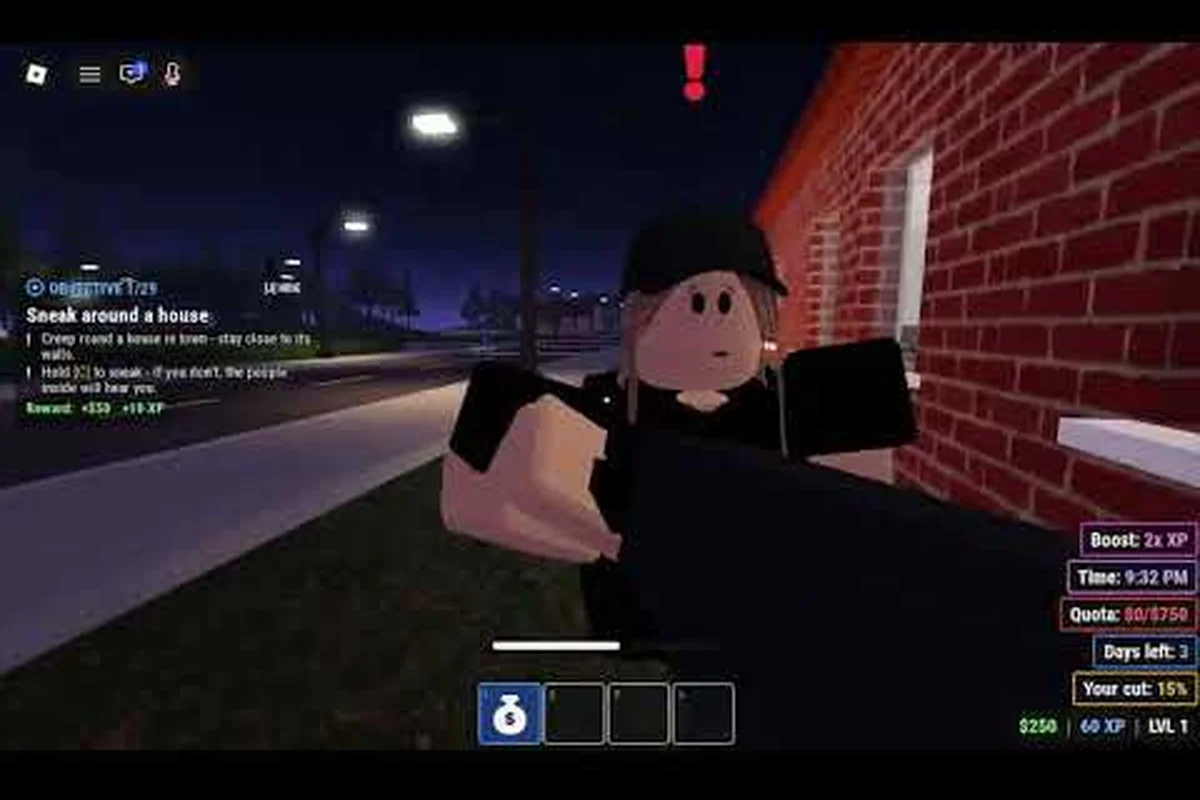
Criminal simulator gameplay mechanics turn each night into a timed teamwork challenge: enter quietly, collect loot, avoid residents, and escape before police and K9 units close in. Understanding the systems below makes every robbery more controlled, especially when debt is waiting and the clock is already moving.
Criminal Simulator Gameplay Mechanics Overview
The core loop combines exploration, stealth, looting, and escape. A crew can operate with one to four players, according to the official Criminal Simulator page on Roblox. The city is the arena, but the night deadline creates pressure because every second spent inside increases the chance of a costly mistake.
The Main Gameplay Loop
Each successful run generally follows a clear sequence driven by the night-cycle timer: the crew’s preparation choices determine which tools are available, while stealth mechanics shift as noise, visibility, and police spawn rules change throughout the shift. For example, delaying entry can reduce resident interference, but it also shortens the window for collecting valuables and reaching the sale point. This creates the central risk calculation in criminal simulator gameplay mechanics: every additional item or detour raises the potential payout while increasing exposure and the chance that police activity interrupts the escape.
-
Prepare the crew before the operation begins.
-
Enter the city at night and identify a target.
-
Avoid residents who can interfere with the robbery.
-
Collect valuables from the chosen property.
-
Respond to police activity if the crew is detected.
-
Escape the pursuit before the deadline expires.
-
Sell the loot and use the proceeds to reduce the crew’s debt.
That sequence creates the tension behind criminal simulator night heist gameplay. You must balance immediate rewards against the time required to return to a safe sale point. Taking every item in a building may increase the payout, but it also keeps the crew exposed for longer.
System Overview
| System | Main purpose | Best player focus |
|---|---|---|
| Night cycle | Limits available operating time | Planning and route selection |
| Stealth | Delays resident and police detection | Cover, pacing, and line of sight |
| Crew roles | Divides responsibilities during a heist | Coordination and specialization |
| Loot spawning | Determines what can be carried out | Target selection and collection speed |
| Police patrols | Escalates pressure after suspicion | Escape routes and distraction |
| K9 units | Tracks suspects over a distance | Breaking sightlines and changing direction |
Understanding these six systems is more useful than memorizing every property. The official page lists more than 5.4 million visits, 92,500 favorites, and roughly 24,800 concurrent players as of October 31, 2026. These figures show a busy live environment, although the Roblox page also marks the experience as an Alpha release, so balance details may change.
What Makes the Systems Interact
No single mechanic decides the run. Opening a container, crossing a camera’s view, or triggering an alarm may affect timing elsewhere in the city. This is the central idea behind criminal simulator gameplay mechanics: efficient crews plan around consequences rather than treating every action as an isolated click.
For a compact introduction to the early-game loop, use the Criminal Simulator first-night guide. It establishes how night heist gameplay begins, how stealth mechanics affect movement through monitored areas, and how police spawn can turn a routine entry into a timed escape. Practicing those basics first makes later optimization of routes, crew roles, alarms, and patrol pressure easier to understand rather than replacing necessary setup with trial and error.
Criminal Simulator Night Heist Mechanics
A successful robbery depends on timing, property knowledge, and the ability to leave before the situation escalates. The night cycle supplies the operating window, while each property’s layout determines how much time a crew must spend crossing exposed spaces. Exposed rooms can be checked with the stealth camera, letting the crew identify guards and security cameras before entry; however, moving through a wider patrol area increases the chance that a police spawn notices suspicious activity. Once an alarm is raised, the escape route matters as much as the initial loot: pausing inside a search zone or crossing a monitored corridor can extend the encounter and give responding officers more time to close in.
Entering and Selecting a Target
The first decision is whether to rob a low-risk property for a dependable payout or attempt a richer location with tighter movement requirements. Since the official description identifies houses and stores as part of the city’s robbery opportunities, players can compare targets according to their risk profile rather than relying on a single fixed route.
| Target consideration | Low-risk approach | High-reward approach |
|---|---|---|
| Property type | Smaller store or accessible house | Denser property with more valuables |
| Time spent | Quick entry and exit | Longer search through multiple rooms |
| Detection chance | Fewer interruptions | Greater chance of meeting a resident |
| Payout | More predictable | Better, but not guaranteed |
| Escape demand | Moderate if unseen | High if an alarm is triggered |
The best target depends on the crew’s current debt, equipment, and confidence. For example, if the crew lacks a reliable escape vehicle or its stealth gear is poorly maintained, an accessible house with a moderate escape demand is safer than a densely packed store with greater detection chance. Completing one clean robbery lets the crew rebuild its debt margin, recover equipment wear, and test the night-cycle escape timing before attempting several ambitious properties during the same night.
Carrying Loot and Managing Time
Loot has value, but carrying it is not the same as securing it: in a criminal simulator night heist, collected items must be brought to a sale point and converted into money before the night deadline. That creates a three-stage calculation based on acquisition value, travel time, and sale time. A crew that grabs every visible item can run out of clock before reaching the buyer, so route planning and load capacity matter as much as choosing targets. For example, a house with several valuables may score higher than a quick store stop, but only if the crew reserves enough time for travel, selling, and exit.
-
Acquisition value: What can be taken from the property?
-
Travel time: How long will it take to reach every chosen objective?
-
Sale time: Can the crew still exit and convert the loot before the deadline?
The official page frames selling loot before the deadline as a central objective. If the crew spends all its time collecting and forgets the sale, it may lose the benefit of a successful robbery. The guide to robbing houses and stores expands on target-specific collection decisions.
Crew Size and Responsibility
The game supports crews of one to four players. More players can cover doors, collect loot, and watch for responders, but they can also create noise or accidental collisions. Smaller crews are easier to coordinate, while larger groups gain more flexibility when everyone has a defined responsibility.
| Crew size | Advantage | Main risk | Practical assignment |
|---|---|---|---|
| Solo | Full control of movement | One mistake can end the run | Use narrow, practiced routes |
| Two players | Easier lookout coverage | Uneven roles can delay exits | One enters while one watches |
| Three players | Faster looting and monitoring | More chance of crowding | Divide rooms and exit paths |
| Four players | Maximum coverage and speed | Communication becomes critical | Assign pairs to separate tasks |
A practical crew plan names every role before entering. One player can handle containers, another watches residents, and the others prepare the escape. During the first night, the survival guide for the night cycle helps translate the schedule into safer decisions.
Criminal Simulator Stealth Mechanics
Stealth works through information control: limit what enemies can see, avoid unnecessary noise, and never remain in one predictable path. For example, moving a stolen item from a back-room hiding place to a moving civilian or vehicle can redirect police patrols, while breaking a nearby window may make the resulting noise pull residents toward the wrong area. Residents and police react to changing situations, so repeatedly repositioning after a patrol passes is often safer than camping in one hiding place until the night cycle ends.
How Stealth Works
The safest route is the route with the fewest reasons for someone to become suspicious. Line of sight is the first concern. Stay behind objects, break long sightlines with corners, and avoid crossing open areas when a resident can observe your movement.
Noise forms the second concern. Running, hurried movement, and repeated interactions may expose the crew even when nobody has a clean visual. The third concern is predictability. A player who repeatedly uses the same doorway or pauses in the same corridor becomes easier to intercept.
| Stealth factor | What it changes | Better approach |
|---|---|---|
| Visibility | How easily a target notices you | Break direct sightlines |
| Movement speed | Noise and exposure time | Slow down near occupied areas |
| Route choice | Number of possible responses | Keep several exits available |
| Timing | Chance of crossing a patrol | Wait for gaps before moving |
| Crew behavior | Combined risk of group mistakes | Use assigned lookouts |
These are the foundations of criminal simulator stealth mechanics. The official listing describes sneaking past residents as a core activity, confirming that careful movement matters beyond simply reaching a loot container. In practice, a successful night heist depends on combining those systems: line of sight determines whether a resident can spot the crew, movement speed controls how much noise each route generates, and timing creates openings between resident patrols. For example, stopping behind a doorway until a patrol passes is safer than sprinting across the corridor, while keeping several exits available prevents a single alerted resident from trapping the crew. The same principles apply when police spawn during a night heist, because visibility and route choice can determine whether the crew escapes before the response escalates.
Moving Through Occupied Properties
Entering through the safest available route is useful, but it does not guarantee a quiet interior. Residents can occupy rooms, corridors, and entrances, so each doorway becomes a potential detection point during a night heist. Before opening another container, pause long enough to check the next space, listen for footsteps or other movement, and compare the visible route with likely patrol paths. For example, moving directly toward a loot container can expose you to a resident entering from a side hallway; checking the adjoining corridor first gives you time to close the container, change position, or retreat before the stealth encounter escalates.
A reliable process has four parts: confirm the entry point is safe, identify which rooms and corridors residents may occupy, listen for movement before crossing an exposed threshold, and plan a retreat or hiding position before opening a loot container. In a night heist, treating a closed container as harmless can cost you the advantage: the search timer, resident patrols, and possible police spawn all become more dangerous when you remain stationary. For example, if footsteps stop outside a doorway, wait for the patrol to pass or move through an adjoining room instead of rushing to the next container.
-
Scan the immediate area for residents and open passages.
-
Advance only when the next section is clear.
-
Collect loot while maintaining awareness of nearby movement.
-
Reposition immediately if a resident appears or reacts.
The multiplayer mechanics breakdown is particularly useful here because crew positioning determines whether one player can watch a corridor while another searches a room. Keep the lookout moving as the team advances, because a static guard can quickly become obsolete.
Distraction Versus Pure Hiding
Hiding helps when a threat has not identified the crew, but it becomes a poor long-term solution when police begin searching. Moving to a different angle can remove a direct search route, while distraction can draw attention toward a different part of the property. The key is to avoid taking the same route a pursuing officer expects.
Criminal Simulator Police Spawn and Patrol Systems
Police pressure escalates when crime is noticed, reported, or left unresolved. The critical question is not merely whether officers exist, but whether the crew has created a reason for them to enter the active area. A witnessed theft, an active search signal, or an unresolved crime report can each trigger police spawn behavior, increasing patrol presence in the affected area. In a night heist, avoiding every officer is not enough: an alarm left active may keep attention on the crew and turn a temporary disturbance into a broader search, making escape, disguise, and timing more important than simply completing the objective.
How Police Spawn
| Escalation stage | Likely pressure | Sensible crew response |
|---|---|---|
| Routine presence | Police patrol without direct pursuit | Hide, observe, and change route |
| Investigation | Responders search near a disturbance | Keep distance and avoid new crimes |
| Active pursuit | Officers pursue a known suspect | Run a planned escape route |
| K9 support | A dog tracks a suspect | Break sightline and alter direction |
This explains the basic crime-to-response chain: players commit an offense, witnesses or another event create suspicion, police spawn or arrive, and the crew must resolve the encounter before it becomes a full chase. Because the build remains in Alpha, treat precise spawn distances and response thresholds as version-sensitive rather than permanent rules.
Reading Police Movement
An officer walking along a predictable street is easier to avoid than an officer who has already seen the crew. Watch direction and body orientation, then move only after the patrol passes the relevant corner. If a chase begins, sprinting in a straight line is rarely the best long-term option because it creates an obvious trail.
The Criminal Simulator police chase guide covers escape routing in greater detail. It also connects well with the stealth rules above: every corner, doorway, and reappearance can either break a pursuit or give the police another visual confirmation.
K9 Units and Tracking Pressure
The official game page specifically mentions K9 dogs, making them a distinct threat rather than ordinary patrol officers. A dog changes the escape equation because direct line of sight is not the only way to maintain contact. The officer and animal can work together, with one applying pressure while the other closes another route.
Community experience is most useful when it explains how the K9 tracking system behaves under specific conditions. A successful escape may depend less on raw speed than on whether the dog can confirm your trail after you alter route, use cover, or briefly interrupt line of sight. This makes K9 units a separate pursuit problem from ordinary police encounters, especially during a night heist when police spawn patterns and visibility are already shaping the escape route.
-
Break continuous visual contact instead of merely running faster.
-
Change direction when the route becomes predictable.
-
Avoid crossing recently exposed areas that officers can sweep.
-
Keep loot secure while moving; an escaped pursuit does not preserve uncollected value.
-
Use building corners and objects to interrupt tracking, because an uninterrupted open sprint is easier to follow.
Criminal Simulator Night Heist Gameplay Strategy
The strongest approach is a repeatable sequence of preparation, execution, and escape. Skilled players do not merely react when police spawn or alarms trigger; they plan acceptable risks, assign teammate roles, and choose a regroup point before entering the target. For example, one crew member can create a distraction with the noise lure while another disables cameras, allowing the team to move through the stealth route before the wanted level rises. If police spawn, this preparation determines whether the crew can complete the night heist or turn the encounter into a failed extraction.
Preparing the Route
Before starting, identify the objective, entry point, loot location, sale point, and at least one fallback exit. If the route has only one door, every unexpected resident or officer becomes a serious problem. A second exit provides options when the original path is blocked.
| Planning stage | Decision to make | Why it matters |
|---|---|---|
| Target selection | Choose a property and expected value | Controls time and exposure |
| Crew roles | Assign looting, lookout, and escape duties | Reduces confusion under pressure |
| Route design | Plan primary and fallback paths | Keeps retreat options open |
| Timing | Reserve enough time to sell loot | Prevents a technically successful but unprofitable run |
| Risk threshold | Define when to abort | Prevents one error from escalating |
A crew should agree on a simple abort signal before entering. Some players use a code for “leave now,” while others use a direct instruction. The method matters less than making sure everyone understands that the signal overrides the desire to collect one more item.
Executing the Robbery
Use short cycles instead of rushing through the entire property. Enter, verify the room, collect the intended loot, and check the route ahead. Repeating this rhythm keeps the crew’s behavior predictable to each other without making it predictable to residents.
The most valuable loot is loot that can still be sold. Players often take on too many objectives, but the official alpha supports one-to-four-player crews without requiring every teammate to rob simultaneously. Dividing the crew can work better when one pair searches while another pair watches the approach.
Escaping and Selling
Begin escape preparations before the final container is opened. Confirm which player carries the most valuable loot, choose the least crowded exit, and keep one teammate behind as a temporary lookout if the crew has that luxury. The team should not return to a property entrance that has already been associated with the crime.
Selling loot closes the loop and turns the physical items into money. This matters because the official page presents debt repayment as the central progression pressure: success is measured by money banked, not merely valuables carried during the final seconds.
Common Mechanical Mistakes
-
Starting with too many targets: Several properties can consume the time needed for a safe sale.
-
Ignoring the exit: A clean room does not help if every available route leads to police.
-
Treating every resident as harmless: One witness can start the escalation chain.
-
Running in straight lines: Predictable movement helps pursuers narrow the search.
-
Carrying everything: Bulk loot slows progress and raises the cost of failure.
-
Selling too late: A full bag provides little benefit if the deadline closes the sale window.
Frequently Asked Questions
What are the main criminal simulator gameplay mechanics?
The main systems are the night cycle, stealth, looting, crew coordination, police patrols, and K9 pursuit. Each activity affects the others: noise can attract attention, residents can trigger a response, and loot must be sold before the deadline. A strong run combines quick decisions with a planned escape rather than rushing through every available objective.
Does the night cycle end the robbery automatically?
The night creates a firm operating window, but players still need to complete objectives and sell loot before time runs out. Simply remaining active near the deadline does not protect unsecured valuables. Reserve part of the night for travel and the sale, because official Roblox information identifies selling the loot before the deadline as a central objective.
How does stealth work in Criminal Simulator?
Stealth depends on controlling visibility, limiting unnecessary movement, and avoiding predictable routes. Residents can expose the crew, while stronger responses may involve police and dogs. Crouch-style caution, corner checks, and maintaining alternate exits help, but the strongest defense is changing behavior when a target notices something rather than standing in one hiding spot.
When do police appear during a heist?
Police can appear when criminal activity is noticed, reported, or followed by unresolved suspicion, although exact response timing may change during the Alpha phase. The escalation commonly progresses from patrol presence to investigation, active pursuit, and possible K9 support. Because precise thresholds are version-sensitive, players should observe each area before assuming that no visible officer means it is safe.
Should a crew rob several properties in one night?
That can work if the crew knows fast routes and leaves ample time to sell everything, but multiple targets increase exposure and complicate escapes. One carefully chosen property is more dependable for a new crew. Additional robberies become practical once players recognize safe paths, can reassign roles quickly, and know when the remaining time is safer to use for exiting than collecting more loot.