
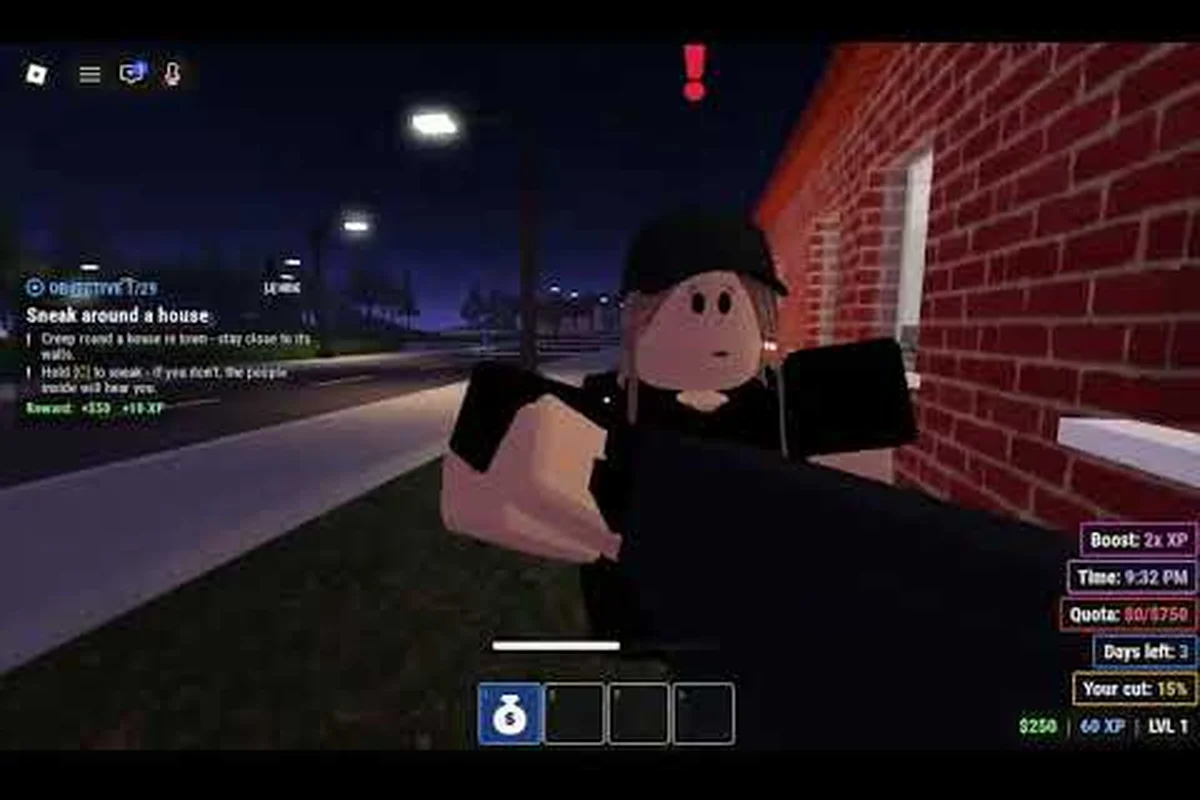
Knowing criminal simulator how to avoid arrest matters because every mistake during a robbery can turn a profitable run into a chase, a lost payout, or a failed debt payment. Use this guide to plan quieter entries, escape police before they close in, and hide when a K9 unit has your scent.
The official Criminal Simulator on Roblox describes a night-based heist loop built around sneaking past residents, outrunning police and K9 dogs, and selling stolen goods before a deadline. The strategy below turns that description into a practical escape plan for both solo and crew runs.
Criminal Simulator escape routes before the alarm
The safest escape is created before police detection becomes a chase. Start by choosing a route with more than one exit, because buildings with a single doorway or street-facing approach make it much easier for police to trap you.
| Escape route quality | Why it works | Recommended action |
|---|---|---|
| Multiple exits | Police cannot cover every exit | Scout doors, windows, and roof access |
| Mixed street types | Patrols are easier to predict on one street | Alternate between alleys and main roads |
| Looped route | You can circle back without exposing yourself | Keep a fallback loop in mind |
| Open plaza | Multiple angles help you break line of sight | Use cover while crossing |
| Narrow dead end | Escape routes become traps | Leave before entering |
Prepare two routes instead of one
A reliable primary route should be short, familiar, and easy to run under pressure. Your backup route should be longer but offer better concealment, such as a sequence of alleys that leads away from the main patrol area. The purpose of the second route is not to make you faster; it is to give you options when the first is blocked.
Before stealing anything, inspect the building's exits and identify where a civilian could block your path. Open areas may look safer, but a group of residents can expose your position or force you toward police. A narrow passage can actually be safer if you have already checked both ends.
Players who focus on preparation can also review how to finish a Criminal Simulator heist before attempting a higher-risk target. That approach helps separate the theft itself from the escape phase, so you can identify which mistakes occurred during entry, which happened while taking loot, and which were caused by rushing the exit.
Use the clock to reduce pressure
The official page identifies selling loot before a deadline as a central part of the run. That creates a tempting mistake: treating the final seconds like extra burglary time. Instead, stop collecting as soon as the remaining window becomes unsafe.
Use these simple checkpoints: first, decide the exact moment to stop taking risks, then work backward to guarantee the buyer can be reached before the sale deadline. A stolen TV may be worth more than a quick detour, but a missed handoff, an alarm trigger, or a blocked exit can turn a profitable run into an arrest. For example, if the remaining time only covers the route to the buyer plus a small buffer, skip the nearby apartment and preserve the exit path; every extra search adds police-response time and reduces the margin for error.
-
Early loot cutoff — Leave enough time to return to a proven exit before the deadline becomes tight.
-
Alarm buffer — Assume that one noisy action, witness, or alerted resident can consume several seconds.
-
Sale-first objective — Once valuable loot is secured, focus on the route to the buyer rather than optional targets.
-
Abort threshold — If police already occupy the likely exit, do not continue searching for extra valuables.
Criminal Simulator stealth tactics that reduce detection
Stealth is the first layer of criminal simulator how to not get caught. The goal is not merely to move quietly; it is to keep police from receiving a clear, actionable description of your position. Breaking line of sight, avoiding groups, and changing pace can all reduce the quality of that information.
Move in short, deliberate bursts
Running draws attention, but standing in an exposed position is worse. Move from one piece of cover to the next, then pause long enough to check the next street or doorway. Long straight sprints make it easier for police to anticipate your route and cut you off.
| Movement style | Detection risk | Best use |
|---|---|---|
| Open sprint | High | Very short distance under immediate threat |
| Normal walk | Medium | Moving between nearby cover |
| Careful approach | Low | Patrol-heavy streets and entrances |
| Stop and observe | Lowest while stationary | Confirming that an exit is clear |
Short movement bursts are more useful than trying to cross an entire district at once. Move to cover, listen for pursuit, and only advance when the next section is clear. If K9 dogs are involved, changing direction and gaining distance matters more than trying to outrun them immediately.
Control witness groups
One isolated resident may be manageable, while a cluster of residents can quickly point out your direction. Approach a target from the side away from pedestrians, wait for groups to separate, or use a distraction elsewhere on the map. The important thing is to prevent multiple people from reporting the same sighting.
Avoid knocking down or threatening witnesses when a quieter route exists. In an alpha-style experience, aggressive actions can accelerate the response, and a witness may remain alive long enough to call for help. If you do create a disturbance, move to a different street before police arrive rather than trying to blend into the same crowd.
Treat K9 dogs as a scent problem
K9 pursuit changes the objective. While a human officer must see or confirm you, a dog can follow a trail. According to the official game description, dogs are part of the police response, so their presence should influence your route from the moment you hear or see one.
| Pursuit factor | Human officer | K9 unit |
|---|---|---|
| Primary tracking method | Vision and reports | Scent trail |
| Best counter | Break line of sight | Break the trail and add distance |
| Common mistake | Running past cover | Staying on the same path |
| Better tactic | Change direction after cover | Cross a different route or surface |
A detailed breakdown of Criminal Simulator police behavior and K9 tracking can help you distinguish a direct visual chase from scent-based pursuit. That distinction matters because a dog may react to a route you already used rather than your current position.
Criminal Simulator how to escape police after detection
Once police spot you, panic reduces the quality of your decisions. Use a three-stage response: create distance, break confirmation, then change the pursuit axis. Simply running in a straight line may work briefly, but it lets officers and dogs concentrate on the same route.
Break the police pursuit in stages
First, move around a solid obstacle. This blocks direct sight and gives you one or two seconds to choose a different direction. Second, do not sprint directly toward the original route. Instead, create a visible lateral change, such as turning into a parallel street after passing cover. Third, slow down only when you are concealed; stopping in the open gives officers a clear reacquisition point.
| Chase stage | Player action | Mistake to avoid |
|---|---|---|
| Initial contact | Put cover between you and police | Sprinting in a straight line |
| Close pursuit | Change streets after covering the corner | Reversing directly toward officers |
| Dog pursuit | Add distance and leave the old path | Returning near the original scent line |
| Loose pursuit | Hide only after the trail is broken | Standing in plain sight |
| Reappearance | Move through a different district | Crossing the same checkpoint again |
The core principle is pursuit-axis change. When police expect you to continue along one road, a perpendicular turn can force them to reorganize. The change does not need to be dramatic, but it should happen after you have broken their view so they cannot simply follow the turn in real time.
Use sound and attention to your advantage
A distraction can pull officers toward the wrong street, but timing matters. Throw or trigger it only after you have passed the nearest cover; otherwise, police may investigate and immediately reacquire you. The best distraction creates a new patrol focus while your body remains concealed.
Do not rely on a distraction when officers already have a clear visual lock. In that situation, the first priority is visual occlusion. Break sight first, then create distance, then consider redirecting the pursuit. This sequence is more reliable than repeatedly relying on one trick.
If a bust happens, reviewing what happens when police catch you in Criminal Simulator helps you understand the consequences and restart priorities. Knowledge of the penalty does not change the outcome, but it can prevent a preventable loss from becoming a costly pattern.
Criminal Simulator hiding spots and recovery tactics
Hiding is a temporary state, not a full escape plan. A successful hide requires cover, patience, and a route that does not lead directly back toward your last known position. If you can see the searchers, you are not hidden; you are merely waiting in the open.
Choose concealment by layer
Use the environment in layers whenever possible. A doorway can break your outline, but an interior room provides stronger concealment. A vehicle or object can block a patrol's direct view, yet movement around it may reveal you if officers search systematically.
| Concealment level | Examples | Reliability |
|---|---|---|
| Weak | Doorway, street corner, parked object | Useful for brief cover only |
| Medium | Interior room, stairwell, enclosed structure | Better when patrol paths remain outside |
| Strong | Off-route interior with alternate exit | Best when the trail can be abandoned |
| Temporary | Cargo, container, vehicle-like cover | Depends on search behavior and access |
Route separation is the most important principle. After hiding, leave through a direction that does not reconnect with the path used before the chase. If police are checking every exit from a small building, stay inside longer and choose a different exit later.
Know when to keep moving
Do not hide merely because a siren becomes distant. Police may patrol back toward a confirmed robbery location, and K9 dogs can recover a scent route. Move again when searchers pass, when the area becomes quiet, or when your selected exit opens.
A practical recovery checklist in Criminal Simulator should account for the wanted meter, police search radius, and nearby K9 units rather than assuming that one escaped disguise solves the encounter. For example, remain behind cover after the robbery while the wanted meter falls, but reposition if a patrol returns to the storefront, a camera confirms your face, or a K9 closes on your scent trail; surviving a sighting can otherwise reset the pursuit timer and create another arrest opportunity.
-
Confirm distance — Make sure no officer or dog has a direct visual.
-
Identify searchers — Count or track the direction in which they are moving.
-
Choose the opposite exit — Select a route that breaks your previous trail.
-
Wait for spacing — Let searchers separate before crossing.
-
Leave quietly — Move at a controlled pace rather than making a dramatic sprint.
For the broader emergency response, Criminal Simulator arrest consequences and last-chance escape tactics provide useful context for deciding when disengagement is better than continued risk. For example, if police have already matched your disguise, reduced the wanted meter, and started closing the search radius, fleeing through a crowded area can turn a recoverable pursuit into a confirmed arrest; the safer decision may be to abandon the robbery route, change clothing, and relocate before an officer or K9 unit locks onto your trail.
Criminal Simulator crew coordination for clean escapes
Solo players must watch several threats at once, while a crew can assign roles that reduce confusion. The best coordination does not involve constant chatter; it uses simple signals, agreed landmarks, and clear decisions about when the heist is over.
Assign one escape leader
Choose one player to monitor police, dogs, and the exit network. Other crew members can focus on loot, doors, or distractions. The leader should call direction changes without repeatedly asking for status. This reduces the chance that several players sprint in opposite directions and draw attention from multiple angles.
| Crew role | Main duty | Avoid |
|---|---|---|
| Escape leader | Track police and choose routes | Chasing loot with everyone else |
| Loot carrier | Secure valuable items | Leaving the agreed route |
| Distraction handler | Create controlled distractions | Triggering them too early |
| Exit watcher | Confirm routes are clear | Wandering into unsecured rooms |
| Backup player | Handle unexpected obstacles | Splitting away without a signal |
Before the robbery, agree on abort conditions. A sensible signal could be a specific location, a repeated warning, or a designated item interaction. Once the condition is met, everyone should leave; spending extra time for one more valuable item can undo a clean escape.
Separate without scattering
Crew members should not scatter in every direction when police arrive. Spread out enough to avoid a group arrest, but keep the routes converging on the same district. Players who split widely may each trigger separate patrols, effectively creating more witnesses and more calls for backup.
Keep a shared fallback point outside the immediate chase area. It should have at least two exits and should not be the same doorway used during entry. A crew that knows where to regroup can still complete a sale or recover abandoned loot without repeatedly returning to the scene.
A reliable criminal simulator how to avoid arrest checklist
The best strategy combines prevention, escape, and recovery. Prevention reduces how often police detect you, escape breaks the first chase, and recovery prevents one mistake from becoming a complete loss. Practice each stage separately so your decision-making remains consistent under pressure.
| Phase | Primary action | Secondary safeguard |
|---|---|---|
| Before entry | Scout exits and patrol areas | Set an early loot cutoff |
| During theft | Work away from residents | Avoid creating a group witness |
| First sighting | Break line of sight | Change direction after cover |
| K9 pursuit | Leave the old scent route | Use parallel paths |
| Concealment | Wait with two exits available | Avoid returning to the chase area |
| Sale | Prioritize the agreed buyer | Leave before the deadline tightens |
| Crew play | Use one escape leader | Regroup outside the scene |
Practice the route without the loot
Before a serious heist, run through the intended escape route while carrying no valuable items. The goal is to learn where patrols turn, where open spaces expose you, and which paths require a long sprint. Once the route becomes familiar, return for a high-risk attempt only if the path remains clear.
Community guides can also help with broader progression. The Criminal Simulator weapons, money, and upgrades community guide by Blueburry covers early-game systems, while NoobBlox’s Criminal Simulator tips and progression video focuses on the money and best-method side of the experience. Neither is an official developer upload, so treat their advice as community guidance rather than confirmed mechanical documentation.
Make one mistake at a time
If you fail, review the sequence rather than blaming the entire route. Did you lose the exit before the alarm, fail to change streets after detection, or hide too close to the old trail? Identifying the first broken link shows what to correct on the next run.
The most dependable routine is to rehearse the escape as a linked sequence, not a series of improvised reactions: use a safe house as the starting anchor, verify the exit route before committing to the robbery, and map one alternate path around the likely police cordon. For example, if a siren triggers while you are moving through a narrow street, stop pursuing the nearest doorway and instead cross a block, change streets twice, then use a parked vehicle or secluded entrance to break line of sight. This reduces the chance that one missed turn collapses the entire plan, which is essential for criminal simulator how to avoid arrest.
-
Enter quietly and keep residents separated.
-
Take the agreed loot without extending the deadline.
-
Leave before the exit is blocked.
-
Break sight first, then change the pursuit direction.
-
Treat K9 pursuit as a trail problem, not a pure sprint problem.
-
Hide with an alternate exit, then leave through a different route.
These habits cover criminal simulator how to avoid arrest while remaining practical for fast, chaotic robberies. The central lesson is that every successful escape begins with a route, every chase ends with a deliberate change of direction, and every recovery depends on breaking the police’s trail before returning to normal movement.
Frequently Asked Questions
What is the fastest way to escape police in Criminal Simulator?
Put solid cover between you and the officers, then change direction instead of sprinting straight down your planned route. If a K9 dog is pursuing you, add distance and leave the path that carries your scent. The goal is to prevent a clear visual or scent lock, not merely to run faster for a few seconds.
Where should I hide after triggering an alarm in Criminal Simulator?
Choose an enclosed spot with at least two exits, away from the route used before the chase. Avoid standing in a doorway or behind a single object, because searchers may see you as soon as they approach. Wait until officers separate, then leave through the less obvious exit and continue changing directions.
Can criminal simulator how to not get caught tactics work with a crew?
Yes, but every crew member needs a defined role. Assign one escape leader, keep loot collection separate from route monitoring, and agree on an abort condition before entering. The crew should spread out without scattering across distant streets, because multiple small groups can attract several patrols and create more opportunities for detection.
Is running away better than hiding after police spot me?
Running works when you can break line of sight and reach a different route. If police already have a clear visual lock, or dogs are tracking your scent, hiding may be safer than continuing across exposed ground. Move to a concealed location with an alternate exit, wait for the search to pass, and then create a new path.