
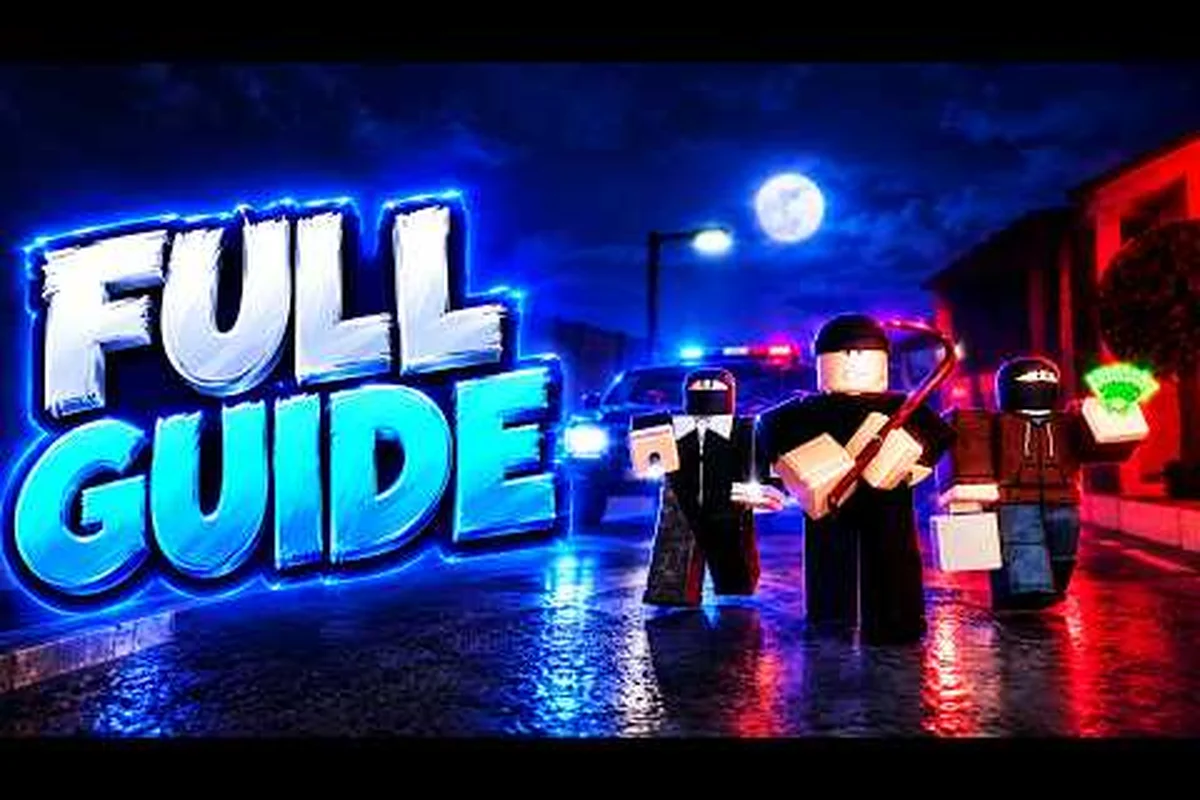
A good criminal simulator police guide turns a failed escape into a controlled retreat rather than a panicked sprint. The core loop depends on staying quiet, managing officers and K9s, and moving with your crew before selling the loot; for example, split the crew between a lookout role and a getaway vehicle so one teammate can monitor police dispatch while the others secure the exit. Use cover and quiet interiors to break line of sight, because every gunshot or visible crew member can escalate the encounter and reduce your escape options. Coordinate the crew through clear calls, keep the vehicle ready near the safe route, and avoid leaving the crime scene before the wanted level begins dropping.
Understanding Police Pressure in Criminal Simulator
Police pressure is the part of Criminal Simulator that turns a profitable night into a frantic run. The official Roblox page describes a night-heist loop in which players rob the city, avoid residents, outrun police and K9 dogs, and sell loot before a deadline. That combination makes positioning, timing, and teamwork more important than raw speed.
A useful criminal simulator police guide starts with recognizing three separate threats. Residents can expose suspicious behavior, officers can pursue or investigate, and K9 dogs can close distance faster than an ordinary sprint. Treating all three as one “police problem” is a common mistake because each threat reacts to different player actions.
Threat categories
| Threat | Main danger | Best response | Avoid |
|---|---|---|---|
| Residents | Spotted suspicious movement | Change route, crouch, wait for attention to fade | Running through populated areas |
| Police officers | Direct pursuit and arrests | Break line of sight, use corners, keep moving | Open-field sprints |
| K9 dogs | Fast tracking and short detection advantage | Change elevation, use solid cover, redirect the route | Staying on one path too long |
| Loot seller deadline | Losing the sale window | Leave early or accept a shorter route | Greeding for extra loot |
| Crew mistakes | Accidental alerts and scattered players | Use short callouts and regroup outside danger | Splitting across the entire map |
The official game page lists support for crews of one to four players, which makes communication a practical mechanic rather than optional commentary. In a four-person crew, everyone can move quietly, but one careless teammate can convert a hidden approach into a citywide chase.
What police encounters mean
| Encounter | Likely interpretation | Immediate objective |
|---|---|---|
| Officer turns toward your position | Suspicion or detection | Break sight and change direction |
| Officer follows the same street | Visual or audio tracking | Put distance between you and the route |
| Dog catches the trail | Sustained pursuit | Use elevation, cover, and a sharp route change |
| Police gather near a stolen location | Area lockdown | Avoid the hotspot and move parallel to it |
| No immediate officer appears | Temporary opening | Complete the objective before noise returns |
The best response depends on the situation rather than a single universal trick. If you have a clear side street, take it. If your crew is separated, create a quiet rendezvous point before attempting a long escape. More detail on these systems appears in the Criminal Simulator gameplay mechanics overview.
Stealth Tactics That Preserve an Escape Route
The best criminal simulator stealth guide is about preserving options. Stealth is not merely standing still; it is controlling what officers know, where your crew can turn, and whether the route to the seller remains usable. A route with several turns and cover points is more valuable than a short straight line through exposed streets.
Start by separating your crew into moving groups only when necessary. Two players can work as a forward pair while the others wait beyond an officer’s sightline, but excessive splitting creates communication problems. Every crew member should know the next checkpoint, the retreat direction, and the signal for immediate silence.
Movement priorities
| Priority | Action | Practical result |
|---|---|---|
| 1 | Stay behind hard cover | Breaks direct visibility |
| 2 | Move at controlled speed | Reduces obvious pursuit triggers |
| 3 | Cross open ground in a planned line | Limits random direction changes |
| 4 | Change direction after cover | Prevents a predictable chase path |
| 5 | Regroup before a final route | Keeps the crew from arriving piecemeal |
Sprinting should be treated as a temporary emergency tool. The game’s official description emphasizes sneaking and outrunning danger, but open sprints create movement patterns that officers and dogs can follow. If a chase has already begun, do not sprint indefinitely in the same direction. Use one long route to create distance, then cut through a covered side path.
The three-break escape method
The three-break escape method turns a developing pursuit into a controlled repositioning sequence rather than a blind sprint. For example, a crew can slip behind a warehouse corner, cut through a side alley toward a parking structure, then regroup before the officer secures a clear visual. Each move should trade police visibility for crew cohesion: the first break tests line of sight, the second breaks the pursuit route, and the third checks that every player remains together with the stolen cargo intact.
-
First break: Put a building corner, vehicle, or similar solid obstruction between your crew and the officer.
-
Second break: Change the route rather than merely running farther down the same street. Turn toward an area with more cover or a different elevation level.
-
Third break: Restore contact with the crew and confirm that the loot is still secure. A successful pursuit break is not useful if half the crew is still surrounded.
This method works because each break removes a layer of tracking information. The first reduces immediate visibility, the second disrupts the established route, and the third prevents a costly mistake caused by splitting up. Community reports consistently treat K9s as a special escalation, so change routes promptly rather than waiting for a dog to close the gap.
Crew Roles for Distraction and Protection
In a criminal simulator crew tutorial, assign roles around the escape plan rather than raw sprint speed. The lookout should monitor police spawns and squad alerts while the driver handles vehicle escape timing; for example, a lookout who spots a patrol cruiser can call the exit route before the crew commits to a getaway. Each responsibility must be transferable if that player becomes separated, trapped, or is taken down, allowing the remaining crew to regroup without exposing every operator to arrest. With the objective of the criminal simulator police guide, consult the Roblox Criminal Simulator game page for the game’s official description and available details.
Recommended crew setup
| Crew size | Recommended roles | Main rule |
|---|---|---|
| Solo | Mobile carrier, route scout, escape planner | Keep distance between objectives and backup routes |
| Duo | Loot carrier, lookout and distraction | The carrier preserves mobility while the other clears the route |
| Trio | Carrier, lookout, rescuer | Do not chase every officer; secure the carrier first |
| Four-player crew | Carrier, forward lookout, rear lookout, rescuer | Pair the rear lookout with the carrier to prevent isolation |
The carrier’s job is to protect the objective, not win every confrontation. Lookouts should watch for approaching officers, communicate danger early, and choose a safe diversion rather than starting an avoidable fight. The rescuer protects the group from being split and creates a return point after a chase.
Distraction choices
| Distraction | Best timing | Strength | Limitation |
|---|---|---|---|
| Sound elsewhere in the street | Before crossing an exposed area | Draws attention without abandoning the carrier | May not fool a nearby officer for long |
| Visual decoy | When officers watch the previous route | Moves the search direction | Leaves the player without immediate cover |
| Crew split with a clear meeting point | When one member must open a route | Creates two movement problems for police | Communication must remain precise |
| Early retreat | When several officers converge | Preserves loot and crew health | May require abandoning extra loot |
Use distractions sparingly. If every teammate moves at once, the crew may look like a coordinated group rather than several independent suspects. A more effective pattern is to keep most players hidden while one teammate creates a visible anomaly, then move the group after the search direction shifts. For larger groups, the Criminal Simulator trio crew guide explains how to balance mobility with mutual protection. The key principle is that every diversion should have an end time and a rejoin route.
Choosing and Changing Escape Routes
Route selection matters because police and K9 patrols turn familiar streets into risk. The best route is not always the shortest. It is the one that combines cover, limited exposure, and several opportunities to change direction before reaching the loot seller.
Build a route in three layers. The first is the approach, which should favor narrow streets and corners. The second is the escape, which needs at least two alternate exits from each major intersection. The third is the final approach to the seller, where you should avoid lingering because the sale deadline is already working against you.
Route quality checklist
| Check | Strong route | Weak route |
|---|---|---|
| Cover spacing | Cover appears every short segment | Long uninterrupted open space |
| Direction changes | Multiple left-and-right options | One long straight street |
| Elevation | Changes between routes are available | Entire route sits on one flat level |
| Crew grouping | Players can regroup behind cover | Members split across parallel streets |
| Seller approach | Direct after the final risk | Crosses another busy district |
| Dead ends | None are required | Escape depends on passing through one |
When a pursuit starts, use a route change rule: move at least two blocks away from your original path before returning toward the seller. This distance gives you time to determine whether officers are still following. If you return too soon, the same chase can resume from a familiar corner.
The Criminal Simulator multiplayer mechanics analysis is useful for understanding how police AI and K9 behavior affect a group. The practical conclusion is simple: four players in a tight formation are easier to track, while staggered movement can create uncertainty without requiring risky long-distance travel.
Surviving K9 Dogs and Tight Police Searches
K9 dogs deserve their own escape plan because they can shorten the gap between your crew and a pursuing officer. Community guides identify them as one of the defining dangers of the night-heist loop, although exact detection behavior may vary with game updates and difficulty. Avoid relying on a single counter that may change during the Alpha build.
A K9 is most dangerous when your route becomes predictable. Repeatedly using the same street, moving in straight lines, or pausing in the same doorway gives pursuing players a strong trail to exploit. The best counter is to use route irregularity: change streets, use different levels, and never remain stationary while a trail is active.
Dog-response table
| Situation | Immediate action | Secondary action |
|---|---|---|
| Dog is visible | Change direction behind cover | Use a higher or lower route if available |
| Dog is close but unseen | Avoid the obvious exit | Move quietly until distance increases |
| Officer and dog travel together | Create a single strong diversion | Lead them away from the carrier |
| Dog follows the crew’s trail | Break the trail with a route change | Regroup after the dog loses direction |
| Dog blocks the only exit | Prepare an alternate approach | Do not charge directly into a trap |
Do not fire a weapon simply to solve every dog problem. Weapon use may remove an immediate obstacle, but it can also increase attention and consume time. A quieter solution is preferable when the deadline is generous enough to let the crew take a safe detour.
If you want a broader look at pursuit behavior, including difficulty and dog AI, see the multiplayer mechanics and police behavior analysis. Treat that information as a current build reference rather than a permanent rule, because an Alpha game can change after its last verification.
Multiplayer Escapes Without Splitting the Loot
A criminal simulator multiplayer tutorial needs to address the moments when players choose different routes. Someone spots an officer, another player wants to keep moving, and the carrier may be on the opposite side of the street. These disagreements become dangerous when each player reacts independently.
Use a compact callout system with three pieces of information: danger, direction, and reunion plan. “Officer left,” “move right,” and “meet by the blue awning” is more useful than a general warning because it tells everyone what to do next.
Communication sequence
| Stage | Example information | Purpose |
|---|---|---|
| Recognition | “Police at the corner” | Confirms the threat |
| Intent | “Carrier stays behind cover” | Prevents accidental exposure |
| Movement | “Move left to the alley” | Gives the group one route |
| Regroup | “Regroup behind the truck” | Recreates a protected formation |
| Exit | “Seller route is clear” | Confirms the next objective |
Do not split up just because one member can see a safer path. A player who leaves alone may save a few seconds but place the carrier, the rescuer, and the remaining lookout in separate pursuit situations. If separation is unavoidable, keep it temporary and agree on a location that does not sit directly on the suspected escape path. The Criminal Simulator multiplayer night-heist guide provides additional context for organizing group heists and keeping a crew’s objectives synchronized. The most effective crew does not merely avoid police; it avoids making several decisions at once.
Error recovery table
| Problem | Recovery plan | What to avoid |
|---|---|---|
| One player is spotted | Route the others away while the exposed player uses cover | Everyone converging on the same player |
| Carrier is blocked | Send the rescuer to create a new opening | Surrounding the police unit together |
| Crew is split | Set one fixed rendezvous point | Calling different meeting places |
| One player lags behind | Hold at safe cover and signal | Leaving the carrier alone |
| Loot was dropped | Plan a quick retrieval before pursuing | Chasing while officers close in |
First-Time and High-Pressure Rescue Plan
Use this sequence when a new crew is learning the system. It begins with reconnaissance rather than loot, because every crew member should know at least one cover-rich route before the first valuable run. For example, pair the driver with a lookout and identify one alley, one service entrance, and one fallback vehicle position; the driver can reposition without exposing the crew to a patrol, while the lookout marks suspicious police activity and calls out whether to split, freeze, or redirect. This avoids turning an early police encounter into a failed getaway and gives the crew a practiced escape plan before committing to loot.
Pre-heist routine
| Stage | Action | Goal |
|---|---|---|
| Plan | Choose one main route and one backup | Avoid improvising during a pursuit |
| Signal | Agree on danger and reunion calls | Speed up decisions without clutter |
| Equipment | Keep the carrier mobile and protected | Preserve escape speed |
| Timing | Leave enough time for the seller deadline | Avoid a rushed final approach |
| Review | Note where officers and dogs appeared | Refine later runs |
During the heist, stop when the route no longer makes sense. If the carrier is visible, the crew is divided, and dogs are nearby, abandon extra loot rather than forcing a heroic recovery. A smaller payout can be sold successfully; a failed escape may cost the entire run.
For solo runs, act as both carrier and lookout. Make short trips, verify cover before entering an intersection, and never let curiosity pull you into a dead end. With a partner, one person can focus on movement while the other scans for pursuit. The Criminal Simulator co-op heist guide provides a useful comparison of solo and group priorities.
Final 30-second checklist
-
Loot condition: Confirm that the carrier still has the objective.
-
Crew contact: Ensure every visible player knows where the group is going.
-
Route state: Check that the planned exit is not already occupied.
-
Dog status: Do not reenter the last known tracking area without a diversion.
-
Seller deadline: Leave early enough to avoid turning a successful escape into a rushed arrival.
The strongest escape plan preserves three assets: the carrier, crew cohesion, and enough time to reach a reliable seller. For example, if the carrier is carrying a high-value objective, keep the crew focused on routing rather than speed; a faster sprint through an exposed street can cost more time than a slower warehouse cut that reduces police contact. If the carrier is empty-handed, the crew can create distance more aggressively because there is no valuable loot to protect. Before committing to the exit, assign one teammate to watch for pursuit while the carrier stays with the main group. This split prevents a chase from scattering the crew, preserves role discipline, and leaves enough time for the final sale instead of turning a successful escape into a rushed arrival.
Frequently Asked Questions
What is the safest way to escape police in Criminal Simulator?
Put solid cover between the crew and officers, then change routes rather than running straight down the same street. Preserve the carrier, communicate danger early, and avoid returning near the path where a pursuit began. The safest escape also leaves enough time to reach the loot seller.
Can K9 dogs be avoided without fighting them?
Usually, yes. Change direction, move to a different elevation level, and break the trail behind cover before a dog closes the gap. Dogs become more dangerous when your crew repeats a predictable route or stops in one place. Use a visible distraction only if the crew has a clear regrouping plan.
Should the crew split up when officers appear?
A limited split can help, but it should follow a fixed communication and reunion procedure. Keep the loot carrier with at least one protector, send another player only when a distraction creates a clear opening, and never choose a meeting point that lies on the suspected pursuit path.
What should a new crew do when the escape route fails?
Do not immediately run the longest possible route. Move behind cover, identify where officers and dogs are, then choose an alternate route that crosses a different street or elevation. Regroup the crew, confirm the loot is secure, and leave the danger zone before committing to another objective.
Is running faster the best way to escape a K9 pursuit?
No. Sustained speed can keep you moving while still producing a predictable trail. A route change after gaining initial distance is often more effective, especially when cover, elevation, and a short crew reunion can be reached before the dog closes the gap.