
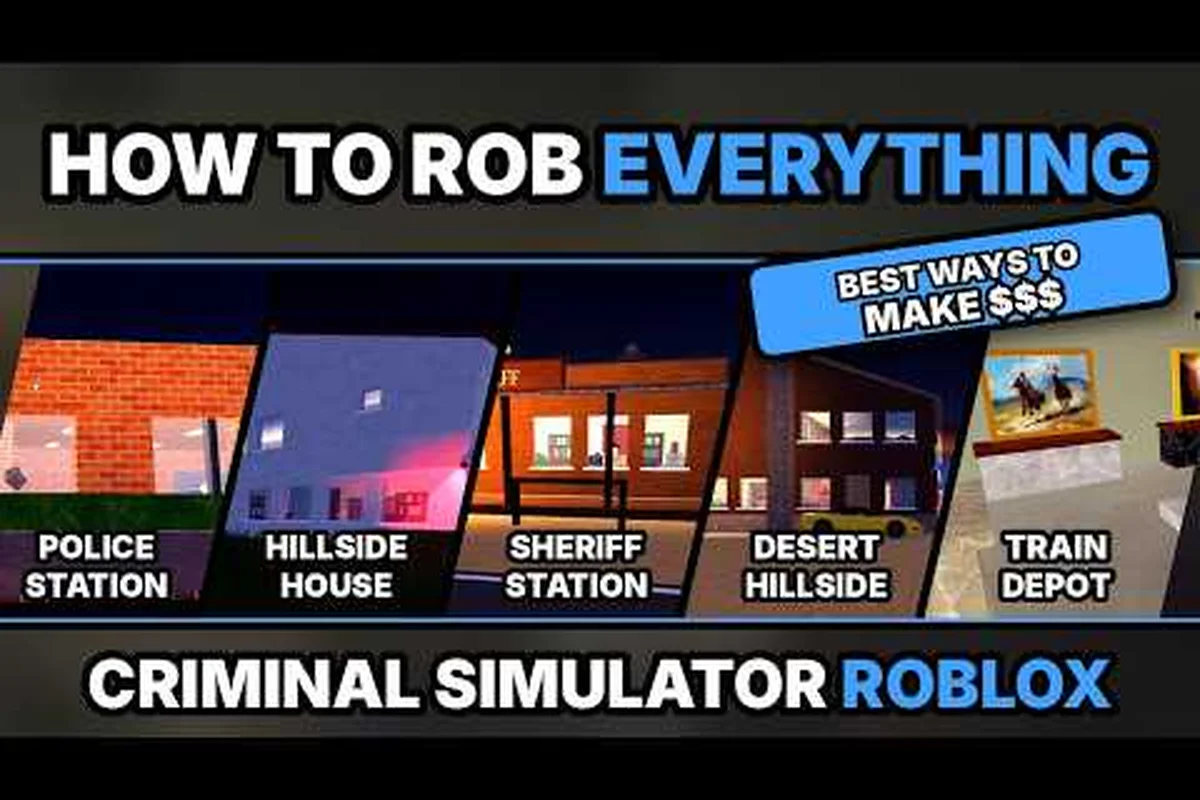
Debt turns the opening nights of Criminal Simulator into a countdown. This criminal simulator debt guide gives solo beginners a practical way to build cash, survive each robbery, and reduce what they owe without treating every run like an all-or-nothing gamble.
Understanding the Debt and Escape Plan
The official Criminal Simulator game page describes a night-heist loop built around robbing the city, sneaking past residents, escaping police and K9 dogs, then selling loot before the deadline. It also supports crews of one to four players. For someone playing alone, that means each decision carries more weight: there is no teammate to watch a pursuit, collect loot, or cover the route to a buyer.
The key distinction is between Debt Progress and Greedy Runs. Debt progress comes from consistently completing smaller jobs, selling loot, and paying down what you owe. A greedy run takes extra risks for a larger payout, which may accelerate repayment but can also leave you empty-handed after a failed escape. A clear Escape Plan should therefore define your route, minimum target, and exit conditions before a run begins.
| Priority | Solo objective | Why it helps |
|---|---|---|
| First | Complete the robbery and return alive | Preserves access to the money you already earned |
| Second | Secure a sellable amount of loot | Creates income for the next payment |
| Third | Reach the deadline | Prevents a deadline failure from wasting the entire run |
| Fourth | Reduce debt reliably | Creates steady long-term progress |
Because the game remains in Alpha, individual values and presentation can change with updates. Treat the strategy below as a flexible operating plan rather than a promise that every update will preserve the same payout balance. The official page had recorded more than 5.4 million visits and 92,500 favorites by late October 2026, suggesting a large early audience, but popularity does not make every route equally safe for a solo beginner.
The solo debt rule
A simple formula is enough: Net Gain = Loot Sold + Cash Kept minus Purchase Costs. If a run shows a negative result, it damages your ability to make the next payment even if the robbery looked successful. Keep enough money for required gear and leave the rest focused on debt reduction.
A practical early target is to lower the debt by a repeatable slice rather than attempting to clear everything in one spectacular heist. Exact debt amounts and payment choices should be checked in the current interface because community reporting and the current Alpha build may not always use identical figures.
Preparing Your First Solo Cash Run
The official Criminal Simulator loop supports both single-player and crew play, so you do not need to wait for a partner. This section of the criminal simulator solo player guide focuses on preparation that reduces mistakes before you enter a dangerous street.
Begin by identifying the gear and route you can handle without constant upgrades. A larger investment can improve carrying capacity, movement, or noise control, but it may also create a Cash-First Trap: spending all available money on gear and leaving nothing for the debt payment. If a purchase delays the first payment without producing a clear operational advantage, skip it until you understand the run better.
| Preparation choice | Beginner-friendly approach | Risk of overcommitting |
|---|---|---|
| Loadout | Use the equipment you already understand | Replacing every item at once |
| Target | Choose a location with a manageable route | Choosing the highest-value target immediately |
| Loot goal | Set a minimum worth securing | Staying after the target is met |
| Exit | Plan a direct route toward the sale point | Wandering while police or dogs close in |
| Money use | Reserve funds for the next debt payment | Buying upgrades with the entire balance |
Your first objective should be consistency, not maximum income. The criminal simulator beginner guide can help you learn the basic controls and progression loop, while this guide focuses on what to do after you understand those fundamentals.
Build a one-player checklist
Use a short checklist before accepting a job: compare the cash remaining after mandatory purchases with the debt payment deadline, then treat one successful sale as the benchmark for the first repayment. For example, if a run requires 500 in starting cash, a 300 payment, and only 200 for essential equipment, the job is too risky unless the loot target clearly exceeds those fixed costs. This turns starting cash, loot value, and the available window into a quick go/no-go test for a criminal simulator solo debt run.
-
Starting cash: Confirm that you can afford every necessary item without preventing a payment.
-
Loot target: Choose a minimum sale value that can support at least some debt progress.
-
Route limit: Pick one exit path and avoid collecting unrelated objectives.
-
Escape trigger: Decide what failure signs force you to abandon extra loot.
-
Sale timing: Leave enough time to sell before the deadline rather than assuming the return trip will be perfect.
-
Recovery rule: If the first attempt fails, change one variable rather than immediately buying a large upgrade.
This approach reflects the official page’s emphasis on sneaking, outrunning pursuers, and selling before time expires. In a solo criminal simulator debt run, those mechanics turn the first payment into a measurable objective: estimate the loot target, subtract mandatory purchases from starting cash, and confirm that the remaining balance can be delivered before the debt deadline. For example, if a 500 payment is due and only 200 remains after essential equipment, prioritize a sale worth at least 300 and avoid detouring for unrelated loot that could delay the payout.
Earning Cash Without Chasing Every Loot
Steady income comes from completing the full loop, not merely grabbing objects. The criminal simulator debt guide should therefore treat the sale of loot as part of the robbery, while the sale itself is a separate stage of the run. If you collect enough valuables but cannot reach a buyer before the deadline, the run still fails.
The game’s official description identifies loot selling as the final stage, while community guides emphasize faster money routes and early progression. A verified community video, Blueburry’s Criminal Simulator guide, covers weapons, money, and upgrades. Treat it as a player-created resource rather than an official rules source, especially because update timing can shift upgrade values and routes.
Choose income routes by consistency
| Income route | Consistency | Solo suitability | Main risk |
|---|---|---|---|
| Short robbery with one clear exit | High after practice | Strong | Learning the escape route |
| Medium robbery with a higher loot target | Medium | Acceptable | Extra time near pursuit |
| High-value target | Lower | Not ideal initially | Getting trapped or missing the deadline |
| Loot sale after a clean escape | Essential | Strong | Reaching the buyer in time |
For Small Route First, select a target where you can enter, collect a defined amount of loot, and leave. For Reliable Sale, treat a successful sale—not a picked-up item—as the unit of progress. For Zero-Bank Run, spend no money during the attempt so the eventual proceeds become available for a payment.
The broader Criminal Simulator money guide can help you compare earning methods, but keep one priority in front: the method must still work without teammates. A route that depends on someone else watching the street may look faster in a crew yet become unreliable when you are the only player responsible for every task.
Protect income from avoidable losses
Never enter a run with no idea where you will sell the loot. Memorize the shortest path from your target to the buyer, and plan a fallback if that path becomes blocked. Police and K9 dogs are central threats on the official page, so a route that merely avoids visible officers may still fail if you leave an obvious trail.
If you carry a weapon, treat it as a temporary solution rather than a reason to keep confronting pursuers. Moving away from the immediate danger often preserves more value than fighting every encounter. Your objective is net money after selling, not the size of one item held at the end of the run.
Paying Down the Debt Without Resetting Your Progress
Debt repayment should follow a budget, not an emotion. When the balance feels frustrating, a player may spend everything on gear or make a risky run with no fallback. Both choices can deepen the problem. This part of the criminal simulator playing alone approach uses Minimum Payment Discipline: pay as much as the current situation safely allows while preserving enough cash for the next attempt.
The official page frames failing to repay debt as a dangerous consequence of the escape scenario, but the current interface should remain your source of truth for the exact consequence, available repayment options, and displayed balance. Do not rely on a fixed number from an old guide if your build shows something different.
| Money state | Recommended action | Reason |
|---|---|---|
| No usable cash after the run | Rebuild income before buying anything | Prevents a debt-spending spiral |
| Small surplus | Make a partial payment if available | Preserves operating funds |
| Comfortable surplus | Pay down debt and keep a reserve | Supports the next run |
| Large surplus | Consider an upgrade only after payment | Keeps the primary objective first |
| Repeated failure | Simplify the route and equipment | Reduces the number of changing variables |
Separate three cash reserves
Divide your money conceptually into three funds even if the game shows one balance: track them separately whenever you earn cash or complete a city job. For example, if a payout leaves you with 1,000 in cash, you could assign 400 to operating costs, 400 to the next debt payment, and 200 to a tested upgrade, then adjust those amounts after each transaction. This makes it easier to see whether debt is shrinking or whether repeated entry and equipment costs are quietly consuming the balance you intended to clear it.
-
Operating Fund: Money for essential purchases and repeated entry into the city.
-
Debt Fund: Cash reserved for the next payment so it is not accidentally spent on cosmetics or unnecessary upgrades.
-
Upgrade Fund: Money set aside for gear that has a clear, tested benefit.
This mental accounting makes the criminal simulator debt guide easier to follow in practice. When the debt drops, move part of the old balance into the operating fund rather than immediately spending everything again. A smaller but sustainable cash cushion is more useful than a large balance that disappears during one purchase.
When to make an upgrade
Buy an upgrade only if it solves a recurring problem. If you repeatedly lose time because your loadout slows you down, a movement-related item may be useful. If repeated thefts empty your balance, capacity could help only if you can still sell the extra loot safely. If every purchase feels necessary, wait for one successful payment cycle before changing the setup.
| Upgrade decision | Buy when | Wait when |
|---|---|---|
| Movement or escape gear | It addresses a confirmed escape problem | It looks impressive but solves no recent failure |
| Carrying capacity | You already sell loot consistently | The route is too dangerous for longer exposure |
| Weapon or tool | It prevents a common bottleneck | It becomes a substitute for good routing |
| Temporary convenience item | It has a clear, short-term payoff | Its cost prevents a debt payment |
Player experiences can identify useful priorities, but they cannot replace in-game testing. The official Roblox listing remains the best place to verify current features, while community guides are helpful for learning what to try during the next session. For a solo player in Criminal Simulator, turn each suggestion into a controlled test: note the starting cash, required debt payment, expected route, and whether the run ends in a sale or a failed escape. For example, test carrying capacity only when a loot route can absorb the added exposure, then compare the extra sale value with the risk of losing that inventory. This makes community advice useful evidence without treating it as a guaranteed upgrade rule, especially since paid items, weapon balance, and Roblox’s debt-payout costs can change between updates.
Surviving Police, Residents, and K9 Pressure
Survival is the financial variable that matters most in a solo run. A robber who wins a confrontation but loses several seconds may still miss the sale deadline, while an escaped robber can preserve every collected item. The guide to surviving the night expands on movement and escape decisions, while the debt plan should use one simple rule: Do not defend a bad position.
Residents, police, and K9 dogs create overlapping threats on the official game page. Trying to defeat every pursuer expands the encounter, gives the police more time to track you, and pushes you away from the direct sale route. Every unnecessary fight threatens the sale value already sitting in your inventory.
Threat-response ladder
| Threat signal | Immediate response | Financial reasoning |
|---|---|---|
| A resident notices you | Redirect and keep moving | Avoid escalating a minor encounter |
| Police appear nearby | Break line of sight and change routes | Preserves loot and remaining time |
| K9 pressure begins | Move away without lingering | Dogs can reduce your ability to escape cleanly |
| Weapon advantage is brief | Use it only to create distance | Do not trade time for a confrontation |
| Exit route is compromised | Use the fallback established earlier | Avoid improvising under pressure |
A Criminal Simulator arrest avoidance guide offers extra route and concealment options, but debt repayment remains the primary objective in a solo run. For example, if a sale would clear only part of the outstanding debt, a detour that delays completion is usually worse than securing the remaining cash; the priority is to preserve loot, finish the transaction, and return the required amount intact. Escape tactics only make financial sense when they create enough time and space to complete that sale without losing the carried value.
Do not let one mistake cancel the run
After a near miss, avoid emotional spending. Write down one cause: missed deadline, detected route, weak loadout, or poor target choice. Change one part of the next run and keep the rest stable. This creates measurable progress and prevents the common loop of repeatedly buying expensive items while changing several variables at once.
Solo play also means there is no automatic signal when another player chooses a safer target. Establish your own stop point based on remaining time, pursuit pressure, and expected sale value. The Stop-While-Ahead Rule is simple: leave once the target is met and the route remains manageable.
A Seven-Night Debt Reduction Plan
A structured plan turns an intimidating balance into a sequence of manageable sessions. The plan below is designed for a solo beginner and can be adjusted to the current build. It does not promise a fixed clearing time because debt totals, payout values, and available payments may change during development.
| Session | Main objective | Cash decision | Performance check |
|---|---|---|---|
| 1 | Learn the basic robbery and sale loop | Keep all available funds | Can you complete a full run? |
| 2 | Repeat the safest route | Reserve the first payment | Did the sale finish? |
| 3 | Make the first partial payment | Do not spend the remainder | Is the debt visibly lower? |
| 4 | Reduce target time spent | Buy only a confirmed upgrade | Is the operating fund intact? |
| 5 | Test one controlled improvement | Pay first, upgrade second | Is the new route reliable? |
| 6 | Rebuild a consistent payday | Maintain a cash cushion | Can you repeat the method? |
| 7 | Review the debt total | Use the largest safe payment | Has the balance fallen steadily? |
Night-by-night decision rules
For Session 1, avoid setting a large cash goal. Your main output is knowledge: where the target is, how loot is carried, where the buyer is, and how long the return takes. If you fail, write down the first major obstacle instead of changing everything at once.
For Sessions 2 and 3, repeat the same target until the route feels familiar. Community data often emphasizes quick money methods, but repeated success matters more here because the solo player receives every payout directly. Once you have completed a second sale, use the payment interface to see whether partial payments are allowed and how they affect the displayed balance.
For Sessions 4 through 6, make one measured change. You might shorten the route, carry less value to improve escape speed, or buy one item that addresses a measured problem. Keep a written baseline for duration, loot value, and whether you reached the buyer. These simple observations are more useful than vague claims that a route is “fast.”
For Session 7, review three numbers: cash before the run, cash after selling, and debt afterward. If the after-sale balance did not rise, change the source of income or improve survival before attempting another large purchase. This is the core of a practical criminal simulator debt guide: measure the complete result rather than celebrating the loot pickup.
Know when to stop experimenting
If two consecutive runs end before the sale, return to the simplest successful route. If the route works but produces too little, improve it gradually. If it produces enough money but the balance keeps disappearing, separate the debt and operating funds immediately. Diagnosing the exact leak is faster than repeatedly changing weapons, targets, and routes together.
Solo Preparation Checklist and Common Mistakes
A strong criminal simulator solo player guide begins before the first robbery. Prepare your inventory, know the payment interface, and define what counts as a successful night. Because the game is still an Alpha experience, verify current labels and requirements in the live client rather than assuming every guide reflects the latest interface.
| Common mistake | What it costs | Better solo rule |
|---|---|---|
| Spending every coin on upgrades | Delays the first payment | Pay first, then evaluate upgrades |
| Selecting the richest target | Increases pursuit pressure | Repeat a modest target until reliable |
| Staying for extra loot | Risks missing the sale deadline | Set a departure trigger before entry |
| Ignoring the buyer route | Can turn good loot into no income | Rehearse the direct return path |
| Changing four things at once | Makes failures hard to diagnose | Change one variable per test |
| Playing as if a teammate will rescue you | Leaves dangerous gaps unattended | Keep every escape within reach |
| Checking debt only after shopping | Hides the real balance trend | Record payment before purchases |
A final preparation pass should include the current debt total, available cash, target route, sale location, escape trigger, and time limit. If you cannot explain the plan in one sentence, simplify it. A solo plan should be specific enough that you can act without another player calling out warnings or covering objectives.
Keep the debt report
Use a simple log with five fields: date, starting debt, cash after sale, amount paid, and the main problem encountered. This makes it easier to distinguish genuine progress from changes in loot value. It also reveals whether you are spending more on equipment than your latest robberies return.
The value of this log rises as the debt shrinks. You can compare reliable income, identify which purchases reduce repeated failures, and determine when the remaining balance requires a slightly more ambitious route. The criminal simulator playing alone experience becomes manageable when every session contributes a measurable data point.
Frequently Asked Questions
Can you clear debt in Criminal Simulator without a crew?
Yes, because the official game page says crews can contain one to four players, so a single-player run is supported. Start with a modest target, rehearse the route to the buyer, and use a payment plan that preserves enough cash for another attempt. Avoid making a high-value target your first solution when a simpler robbery is already producing income.
What is the best way for a solo beginner to make money?
The best method is the route you can complete repeatedly, not necessarily the one with the largest advertised payout. A successful run must include the sale, because unsold loot provides no income. Use the money guide to compare options, then test one controlled route and record its net earnings.
Should a solo player buy upgrades before paying debt?
Usually, no. Paying the debt first protects your progress and keeps the operating fund from disappearing into gear. Consider an upgrade when it solves a repeated problem, such as consistently losing valuable time during an escape. Pay what you can, keep a small reserve, and then purchase only an item with a measurable benefit.
Is playing alone harder than joining a crew?
Solo play is harder because one player must handle the robbery, awareness, escape, and sale without teammate support. It can also be more consistent, because nobody else selects the target or spends the payout. Use a simpler route, communicate intentions through clear stopping rules, and review failed runs to identify the exact stage where time or loot was lost.
How often should I check the debt balance?
Check it at the end of every successful sale and again before making any purchase. This prevents upgrades from consuming money that should reduce the balance. Keep the operating fund separate in your own notes, record each payment, and compare the remaining debt after each session so you can see whether your current method is truly making progress.