
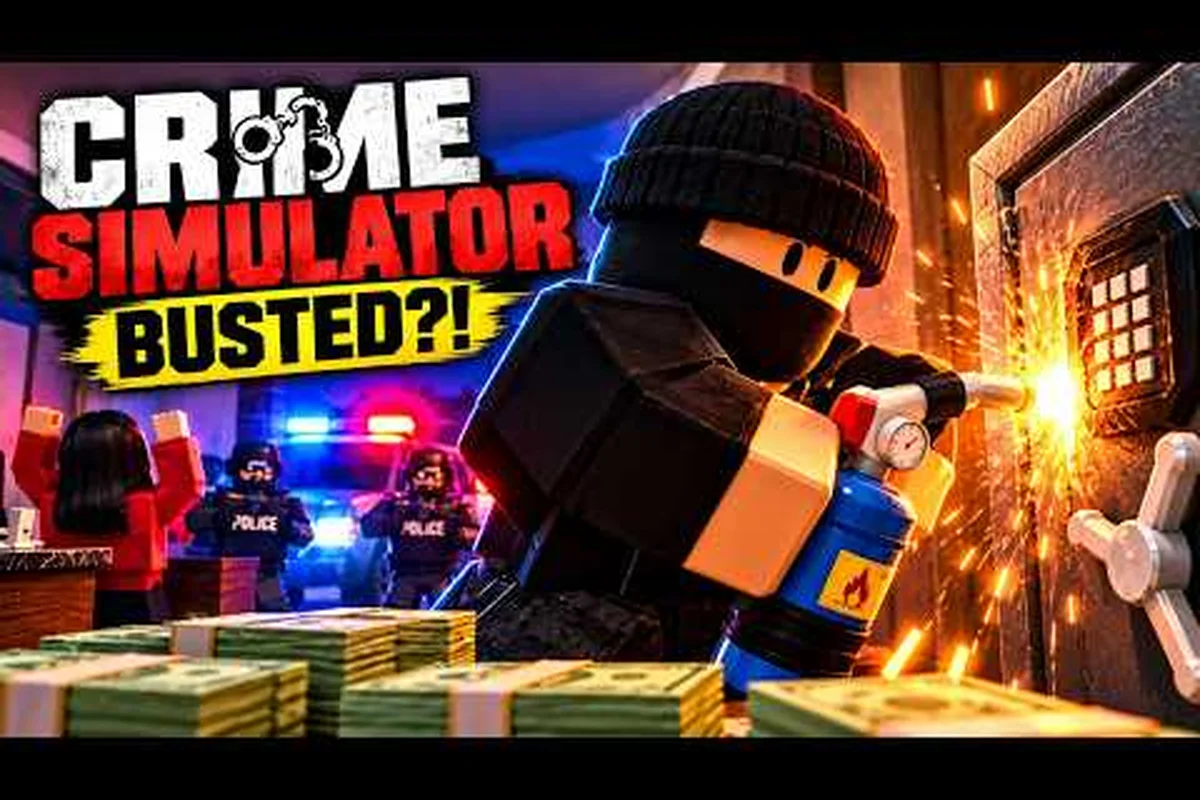
Criminal Simulator server size determines the scale of each Roblox heist, from solo robberies to four-person crews. The official page lists 16-player servers and supports crews of one to four, so learning the city map and nighttime targets can turn a crowded match into a coordinated escape.
Criminal Simulator Server Size at a Glance
The current Criminal Simulator server size is 16 players per server, according to the official Criminal Simulator game page. A session can therefore contain several separate crews rather than one continuous group. The game supports one to four players per crew, giving groups room to divide responsibilities without requiring every player to follow the same route.
That distinction matters because the population of a server and the size of your crew are different numbers. Sixteen participants may be spread across multiple robberies, patrols, and escapes. Your immediate team remains smaller, which makes communication and role assignment easier to manage.
| Criminal Simulator detail | Current value | Practical meaning |
|---|---|---|
| Players per server | 16 | Several small crews may operate at once |
| Players per crew | 1–4 | Solo runs and groups of two to four are supported |
| Primary setting | City at night | Visibility and patrol routes shape each heist |
| Game status | Alpha | Balance and features may change |
| Core objective | Steal loot and sell it | Players must manage time, stealth, and escape |
| Main threat | Police and K9 units | Players cannot rely on speed alone |
What the 16-player limit changes
A 16-player server creates opportunities for deliberate distractions. One player can draw attention in one district while a teammate enters a residence elsewhere. Another crew may also be moving through the same area, which makes it important to distinguish teammates from rival players instead of assuming every moving character is hostile.
Because the supported crew size is smaller than the server capacity, good teams can divide into a scout role, entry role, carrier role, and escape role. Solo players should instead plan a compact route that minimizes repeated travel and avoids exposing themselves near the final sale point.
| Player count | Recommended structure | Main advantage |
|---|---|---|
| Solo | Loot, carry, and escape in one route | Full control over timing |
| Duo | Loot and distraction | A second pair of eyes covers patrols |
| Trio | Entry, carry, and lookout | Better route control without heavy coordination |
| Four-player crew | Two teams or a complete heist unit | Maximum flexibility for split routes |
Alpha features and balance
Because Criminal Simulator remains in Alpha, player counts, routes, loot availability, and police responses may change as the developer expands the experience. The current numbers are useful for planning a session, but they should not be treated as permanent balance guarantees. The official listing describes an Alpha night-heist experience built around stealing from the city, avoiding residents, escaping police, and selling loot before a deadline.
That deadline creates the biggest practical constraint on a crowded Criminal Simulator server. Even if the player count can keep multiple police responses and loot routes active, waiting for a vault, residence, or storefront opening can consume much of the heist window. For example, spending several minutes queuing for an accessible loot spawn may leave too little time to escape a police response, reach the sell point, and complete the night map before the deadline; server size therefore affects session pacing as much as total capacity.
Reading the Criminal Simulator Night Map
The Criminal Simulator night map is designed around a simple tension: darkness helps players move between targets, but police and K9 units can still threaten exposed routes. The city layout rewards players who identify their destination before entering an area, since random wandering can consume the selling window and alert nearby patrols.
The map is not a flat checklist of identical buildings. Residential areas, streets, shortcuts, and possible sale locations create a network of decision points. A strong route links a target to a viable escape, while a weak route repeatedly crosses the same patrol zone.
Core map-reading principles
Start with the objective rather than the scenery. Decide where the loot will be sold, then work backward to determine which properties can be reached before the deadline. From there, identify the streets connecting those points and mark any open areas that could expose the crew.
| Map element | What to examine | Why it matters |
|---|---|---|
| Residential blocks | Number of targets and spacing | Closely packed targets can shorten looting time |
| Main streets | Police travel lanes | Crossings may create dangerous exposure |
| Side streets | Visibility and shortcuts | They may offer safer movement at the cost of distance |
| Sale point | Travel distance and congestion | The final route determines whether loot reaches buyers |
| Patrol zones | Approach and escape directions | Leaving through the same route can create a chase |
The best route is not always the shortest line on the map. It is the route that balances travel time, target density, and escape pressure. A slightly longer path may be safer if it avoids the street where a patrol repeatedly turns. This becomes especially valuable in a full 16-player server, where many simultaneous heists can pull attention toward central areas.
Route-planning examples
Imagine two crews facing the same sale deadline. Crew A selects distant properties because their icons looked attractive, then crosses busy streets several times. Crew B chooses nearby targets, completes the robberies quickly, and approaches the sale area from a less obvious direction. Crew B may carry less loot, but it has a better chance of completing the run.
| Route choice | Loot potential | Time and risk | Better for |
|---|---|---|---|
| Nearby clustered targets | Moderate | Lower travel time | Tight deadlines |
| Distant high-value targets | Potentially high | Longer and more exposed | Groups with good coordination |
| Direct route to sale | Depends on targets | Predictable but contested | Experienced crews |
| Indirect escape route | Usually same haul | Slower, potentially safer | Crews carrying heavy loot |
Understanding the Criminal Simulator city map is not about memorizing one perfect route. Since the Alpha map can change, focus on relationships between blocks, roads, and the clock. Players who understand why one street is dangerous can adjust when a patrol shifts or when another crew causes unexpected commotion.
Criminal Simulator City Layout and Loot Targets
The Criminal Simulator city layout gives players several ways to earn money, but the most useful targets are the ones that can be reached and exited without forcing a long confrontation. Target value alone does not measure efficiency: distance, access time, visible exits, and the position of the sale point can matter more than the item's apparent worth.
For a first visit, the Criminal Simulator first-night guide provides a sensible foundation for learning the core loop. Once that loop is familiar, focus on identifying repeatable pockets of loot instead of treating every property as a mandatory stop.
Target selection checklist
Evaluate a potential location using four questions. Is it near the route you already need to travel? Can you see more than one exit? Will residents or patrol noise make a quick search risky? Can the crew remain together, or would splitting up waste more time than it saves?
| Target profile | Estimated effort | Loot efficiency | Recommended approach |
|---|---|---|---|
| Distant isolated property | High | Potentially strong | Worth it only with a clear escape |
| Cluster of nearby homes | Medium | Strong | Best default for early and timed runs |
| Central commercial target | Medium to high | Variable | Approach after nearby options are secured |
| Exposed location | High | Unpredictable | Avoid unless the route creates a distraction |
| Empty or exhausted property | Low | Low | Skip and move to another target |
Community reports often focus on the biggest items, but reliable runs depend more heavily on time efficiency and sell access. A property that produces less loot but sits beside the next objective can be worth more than a high-value stop that sends the crew across the map twice.
Reading loot spawns safely
Loot spawns may vary as the Alpha experience develops, so avoid treating an unverified property list as permanent. Enter a building only when you have a path out, and do not remain inside after obtaining enough value for the run. Every additional search adds exposure because nearby residents can react to suspicious activity and police can close in.
A useful test is to compare the property with your available time: if the Criminal Simulator server deadline leaves enough minutes for a route across the city layout, you can inspect a second loot spawn; if it does not, select one nearby property and exit before police react. For example, treat a ten-minute window as a single-search limit rather than assuming the night map offers enough time to cross between districts, especially when the current Criminal Simulator alpha loot spawns may change.
| Remaining time | Target behavior |
|---|---|
| Ample | Search nearby properties, then evaluate one optional target |
| Limited | Choose one compact route with clustered loot spawns |
| Critical | Carry the current haul to the sale area immediately |
| Already chased | Prioritize escape over additional loot |
The core lesson is straightforward: the Criminal Simulator city layout becomes easier to read when you treat loot as part of a route. Randomly entering buildings creates unnecessary variation. Planned entries make it easier to leave before a patrol closes the street and to avoid arriving at the sale point after the deadline.
Criminal Simulator Loot Spawns and Route Efficiency
Loot spawns determine the raw value of a run, but route efficiency determines whether that value is usable. Criminal Simulator loot spawns should be evaluated as part of a chain that begins with entry, passes through carrying and avoidance, and ends with a sale. Any weak link can ruin an otherwise productive heist.
Because the game is in Alpha, spawn details may change with updates. Reliable strategies therefore depend less on memorizing one room and more on applying consistent rules: choose compact clusters, secure exits, avoid repeated patrols, and sell before the timer removes the opportunity.
Turning locations into a profitable chain
The most reliable approach is to build a loop rather than a point list. Select a starting property near one side of the route, work through a cluster, and finish at a location that allows a direct sale. The crew can carry only what it can protect, so dividing loot among players may reduce the damage from one failed escape.
| Route stage | Primary objective | Failure prevention |
|---|---|---|
| Approach | Avoid the first patrol intersection | Watch the street before committing |
| Entry | Collect useful value quickly | Set a short time limit |
| Looting | Avoid overextending | Leave when the target threshold is met |
| Extraction | Preserve the haul | Use a route away from patrols |
| Sale | Finish before the deadline | Begin the sale trip early |
Players seeking a more detailed approach can consult the Criminal Simulator selling tips guide for ways to compare routes, protect loot, and make better delivery decisions. The core principle remains that a sold haul is worth more than a larger unsold haul, because danger increases the longer valuable cargo remains exposed.
Solo and group loot priorities
A solo robber benefits from choosing one route and executing it quickly. A group can divide labor, but splitting too aggressively may create communication gaps. In a 16-player server, the presence of other crews can also make a crowded exit more dangerous.
| Crew situation | Best priority | Avoid |
|---|---|---|
| Solo run | Shortest complete cycle | Broad cross-map collection |
| Duo run | Parallel scouting | Both players entering the same target |
| Trio run | Carry protection | Leaving one member without a role |
| Four-player crew | Two-route flexibility | Splitting into three tiny groups |
| High police activity | Collective escape | Continuing the loot search |
Criminal simulator loot spawns become less important when the team has already collected enough for its goal. Define that goal before leaving the first property. For a short run, a smaller haul may be enough; for a longer route, target efficiency can compensate for lower-value spawns.
Criminal Simulator Alpha Mechanics for a Full Server
Criminal Simulator alpha mechanics combine stealth, time pressure, carrying loot, and coordinated escape. In a server with as many as 16 players, those systems interact. Another crew can create a distraction, but police attention may also follow the noise to a route your crew planned to use.
Understanding the mechanics means separating what you control from what changes around you. Your crew controls its target choice, movement speed, carry assignment, and sale timing. The server controls the other players, patrol patterns, available openings, and the passage of the deadline.
Mechanics that shape a successful run
The central mechanic is risk management. Steal enough to justify the trip, remain below the attention threshold when possible, and leave before a chase forces a desperate escape. In a crowded server, the cost of failure rises because police can pursue through streets already occupied by other players.
| Alpha mechanic | Solo effect | Crew effect |
|---|---|---|
| Night visibility | Easier to misread distance | Shared watch reduces mistakes |
| Resident reactions | Noise can expose one route | Teams can create distractions |
| Police pursuit | Less room to absorb mistakes | Members can split or protect the carrier |
| K9 units | Adds a separate detection threat | Requires attention beyond player patrols |
| Sale deadline | Favors concise targets | Requires an agreed sale time |
| Carry load | Encourages quick selling | Rewards balanced loot distribution |
The broader Criminal Simulator gameplay mechanics overview explains how the night cycle, stealth, and police responses interact. That context matters when a server becomes busy: a pursuit that seems unfair in isolation may be the result of earlier noise, a failed robbery nearby, or another crew drawing officers toward your intended exit.
Managing attention in a busy match
Treat sound and visible movement as a budget. Every suspicious event makes the next street less predictable. If your route crosses the same intersection twice, assume officers may remember that area. If you separate from the crew, leave an agreed recovery point rather than improvising in the middle of a pursuit.
| Server situation | Recommended response |
|---|---|
| Quiet streets and little police presence | Expand the route slightly |
| Multiple robberies occurring nearby | Keep the carry route away from the center |
| Police crossing a planned street | Wait or use the alternate approach |
| Other crews crowding a target | Select another cluster |
| K9 unit visible | Avoid open crossing points |
| Deadline approaching | Sell the current haul |
These alpha mechanics favor calm, deliberate adjustments. Players who react only when a patrol appears tend to make the largest mistakes, especially in a full server. Watching the intersections before entering a block can prevent a chase that would otherwise consume the entire run.
Criminal Simulator Crew Planning on 16-Player Servers
A four-player crew is only one part of a 16-player server. The remaining participants may form other crews, roam independently, or create distractions. This makes crew planning more flexible than simply choosing one route and following it in a tight group.
The Criminal Simulator co-op guide explains how teammates can share responsibilities and protect valuable loot. Within a crowded match, those roles should still adapt to current police activity rather than remaining rigid.
Assigning roles by situation
At the start of a run, choose a primary route and one fallback. Assign a lookout, an entry player, a carrier, and a flexible support member when playing with four. If all four players need to carry loot, the crew may become slower; if nobody carries, other players will race to collect items and scatter the formation.
| Role | Main task | Adjustment during pursuit |
|---|---|---|
| Lookout | Watch patrol approaches | Move ahead and mark safe crossings |
| Entry player | Secure the target quickly | Assist the carrier instead of searching |
| Carrier | Protect the main haul | Choose the safest sale approach |
| Support | Handle distractions or backup | Create noise away from the carrier |
Good coordination does not require constant talking. Agree on landmarks, use clear danger signals, and decide in advance whether the group sells immediately or waits for a better opening. A simple rule such as “loose formation after a chase” can prevent the entire crew from following one player into danger.
When to group up or split
Grouping is strongest when entering a target, carrying a major haul, or crossing an exposed district. Splitting is useful for checking two nearby clusters or creating a distraction. The split should have a time limit because two groups cannot coordinate indefinitely after the route changes.
| Situation | Formation |
|---|---|
| Two targets are adjacent | Split briefly, regroup at a fixed exit |
| Police patrol the sale street | Create a diversion one block away |
| One player has the main haul | Keep the other players around the carrier |
| A property has several exits | Divide exit watch, not the entire crew |
| Server is crowded with rival crews | Avoid contested properties |
A larger Criminal Simulator server size can provide more room for escape routes, distractions, and player positioning, but it does not make direct confrontation automatically safer. On a criminal simulator night map, low visibility and separated loot spawns can make a distraction more effective than an immediate fight; on a criminal simulator city map, alternate exits let a crew redirect a patrol while protecting the carrier. Timing matters too: leaving a crowded property early may prevent a rival crew from locking down the exit, whereas waiting too long can turn a controlled retreat into a prolonged response.
Practical Criminal Simulator Server-Size Planning Checklist
The fastest way to improve is to compare the same variables after each session: crew size, route length, time to sale, pursuit frequency, and value delivered. Keep a simple record of what happened so that improvements are based on results rather than a vague feeling that a map route “felt good.”
| Metric | What to record | Why it helps |
|---|---|---|
| Crew size | Solo, duo, trio, or four | Shows which team structure performs best |
| Target count | Buildings entered | Reveals overextension |
| Loot value | Total sold | Measures actual run efficiency |
| Sale time | Time from first entry to sale | Highlights slow routes |
| Pursuits | Number and cause | Identifies avoidable exposure |
| Map outcome | Clean, crowded, or chaotic | Connects results to server conditions |
Pre-Entry Cluster Planning
Choose one cluster rather than the entire map, identify two exits, and assign a time at which the crew will abandon further searching. These choices reduce the most common failures: getting caught far from the sale point, splitting too widely, and spending the final minutes on a low-value property.
During the first robbery
Enter only after checking the street, then collect the most accessible valuables first: prioritizing visible loot spawns reduces exposure before the crew reaches its target value. If residents react or police appear, leave immediately rather than chasing additional loot; losing the sold haul cannot be offset by a slightly larger payout, especially when the city map and night-map routes force a longer escape through illuminated streets.
Time the Sale With a Safety Margin
Call the sale early enough to account for police movement and other crews. The carrier should not cross a contested road simply because it is the shortest route. Compare the visible risk with the time remaining and choose a safer approach.
After completing a run
Record whether the bottleneck was target selection, navigation, pursuit, or timing. A pursuit problem may require better lookout positioning, while a navigation problem may require choosing clustered targets closer to the sale point. Separate the causes so the next route improves one variable at a time.
Frequently Asked Questions
How many players are in a Criminal Simulator server?
Criminal Simulator supports 16 players per server, while an individual crew can contain between one and four players. Because the server is larger than a full crew, several groups may rob and escape at the same time. This creates useful distraction opportunities but also increases competition around valuable properties and sale routes.
Can four friends form a crew in Criminal Simulator?
Yes. A four-person crew is the largest supported team, and the available player slots make it practical to assign different jobs instead of sending everyone to the same property. Keep one player focused on the carrier and another on patrol approaches, because a crowded server can punish a formation that loses sight of its own team.
Does the Criminal Simulator city map change during Alpha?
The city map can change while the game remains in Alpha, including the availability of loot and the difficulty of police encounters. Avoid relying on an outdated route list. Instead, memorize the relationship between clustered properties, streets, patrols, and the sale point, because those principles remain more useful than one temporary path.
Where are Criminal Simulator loot spawns found?
Loot spawns are located inside properties the crew can enter during a nighttime robbery, but their exact distribution may vary as the Alpha build evolves. Efficient players choose clusters of nearby properties, collect enough value quickly, and leave before police or residents turn a simple search into a pursuit. The location matters less when the route to extraction is poor.
Does server population affect Criminal Simulator alpha mechanics?
Yes. A full 16-player server can place multiple crews near the same targets and sale points. Other robberies may distract police, but they can also redirect patrols toward your route. Secure a modest haul, protect the carrier, and adapt the approach when the surrounding streets become crowded.