
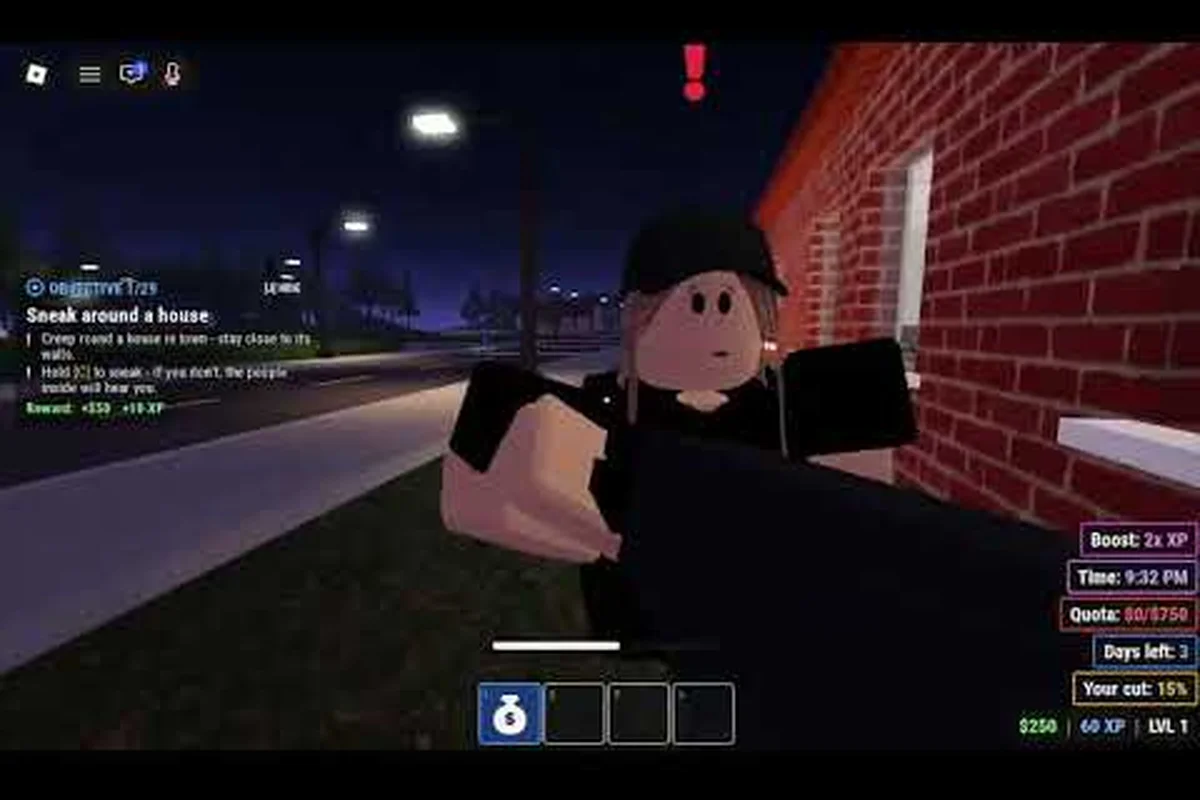
Surviving a chase in Criminal Simulator comes down to reading police heat, breaking line of sight, and choosing routes before officers close in. This guide explains the practical escape decisions that can turn a dangerous encounter into a successful getaway.
Police Chase Fundamentals for a Clean Escape
A successful escape starts before the first siren. Police heat determines how aggressively officers react, while a visible pursuit is much more dangerous than a suspicious moment. The official Criminal Simulator game page on Roblox describes a night-based heist loop built around sneaking past residents, outrunning police and K9 dogs, and selling stolen goods before the deadline.
That structure makes every escape decision more important. Once a patrol sees you, remaining visible gives it more opportunities to follow. A better strategy is to create distance, turn corners, conceal your character, and confirm that the pursuit has weakened before returning to the street.
| Chase condition | Player priority | Best immediate action |
|---|---|---|
| Officer only briefly spots you | Prevent escalation | Duck behind a solid obstruction |
| Officer maintains visual contact | Break the sightline | Turn through alleys or buildings |
| Multiple officers converge | Avoid open ground | Use a corner and change direction |
| K9 unit joins the pursuit | Break scent and sight | Add vertical separation if available |
| Loot is already secured | Preserve the payoff | Reach a safe drop or selling point |
Read the Warning Signs
The first warning is usually a patrol changing direction toward your character. That does not necessarily mean an arrest is immediate, but it does mean the safest choice is to reduce visibility before continuing the robbery. The detailed breakdown of police behavior and chase mechanics can help you distinguish a routine patrol from an active hunt.
Player reports also emphasize that speed alone rarely solves a pursuit. Sprinting down a straight road often keeps the officer in sight, while a deliberate turn through a narrow route can interrupt that visual lock. The aim is not simply to run faster; it is to make the next correct route impossible for the officer to follow.
Plan the Robbery Around the Exit
Before entering a location, identify at least two escape routes and one place where you can break line of sight. Favor an exit that turns immediately behind a wall or leads into a building rather than one that opens across a wide road. This makes criminal simulator breaking line of sight easier because you avoid exposing yourself during the turn.
| Route quality | Characteristics | Escape value |
|---|---|---|
| Direct street | Long sightlines and frequent crossings | Low |
| Corner route | Sharp turn behind a solid obstruction | Medium |
| Alley route | Narrow space and limited visibility | High |
| Interior cutoff | Walls, corners, and multiple exits | Very high |
A route also becomes less reliable when it depends on jumping over fences or crossing exposed areas. Use it only if you have another option when the obstacle becomes blocked. Good escape planning accounts for what happens when the first path fails.
Break Line of Sight Without Getting Trapped
Breaking line of sight requires more than hiding behind an object that officers can see around. A clean cutoff occurs when the wall, building corner, or terrain blocks the officer’s view and gives you enough time to alter direction. Players should aim for a full visual break, not a momentary flicker behind a thin post.
The fastest method is usually a sharp turn followed by immediate movement through the new route. Stopping after the turn can leave you stationary in the open, while continuing on the same axis allows the officer to round the corner. The best route therefore changes both direction and exposure.
Use Cover in Layers
Cover becomes more useful when arranged in layers. One barrier can block the first sightline, but a second barrier can stop an officer who moved to a different angle. Move from the near obstruction to the far obstruction instead of stopping beside the first one.
| Cover position | Result | Risk |
|---|---|---|
| Directly beside a short barrier | Officer may see around it | High |
| Behind a full wall | Sightline is blocked | Low |
| At a building corner | Angle hides your body | Medium |
| Inside a room with multiple exits | Pursuit becomes predictable | Low |
| On an exposed rooftop or platform | Visibility improves for pursuers | High |
The principles of escaping police in Criminal Simulator are especially useful when a K9 unit is involved. A dog can close the gap quickly, so you should avoid feeding it a direct sprinting line and instead create a route with corners, elevation changes, and interruptions in your trail.
Move After the Officers Turn
Once an officer runs toward your previous position, the best move is often across a nearby connection rather than deeper into the same street. Cross streets, alleys, rooftops, and interior access points become safe only after the pursuer commits to the old route. This is the practical value of criminal simulator dodge the police tactics: predict the pursuit path and move where it is not.
Community guides emphasize this difference between escape and evasion. Running directly away may preserve a short-term gap, while alternating between sprinting and controlled movement can keep officers searching rather than tracking. This Criminal Simulator guide reflects the community’s broader focus on movement, money, and useful methods, although individual routes can change as the game evolves.
Manage Police Heat During the Evade
Police heat is the pressure that turns a local escape into a citywide hunt. A short burst of running may create suspicion, but repeated sightings can escalate the response. The goal of criminal simulator police heat management is to reduce that pressure while keeping enough mobility to leave the area.
Because the game is still labeled an alpha experience, exact heat thresholds and spawn rules may change. Verified community information supports the broader loop of sneaking, outrunning police and K9 dogs, and selling loot, but do not treat unlisted timers as fixed facts. The official Criminal Simulator listing is the best place to verify current availability and status.
Choose the Lowest-Heat Objective
You do not need to win a long running contest with the police. You need to accomplish one specific objective: reach a selling point, secure the loot, or return to safety. Direct movement toward that objective is usually better than searching for a perfect hiding place while officers remain nearby.
| Current status | Best objective | Why it works |
|---|---|---|
| One officer is searching | Reach a nearby cutoff | Lowers immediate capture risk |
| Several officers are nearby | Leave the district | Reduces the number of search angles |
| K9 is tracking | Create layered distance | Removes the direct scent trail |
| Loot is secured | Reach the drop or seller | Converts pursuit risk into profit |
| Heat is high | Avoid main roads | Limits new sightings |
If you need a broader explanation of the night cycle and how police encounters fit into the larger robbery loop, the Criminal Simulator gameplay mechanics overview provides useful context. The key principle is that escape is one phase of the heist, not the entire objective.
Understand Escalation Without Guessing Exact Timers
Community experience suggests three practical levels of pursuit. A patrol may investigate a suspicious area, an active chase follows a confirmed target, and a wider response involves several officers or a K9 unit. These are behavior categories rather than exact heat values.
| Pursuit level | Likely signs | Recommended response |
|---|---|---|
| Suspicion | A patrol pauses or changes route | Hide before it confirms your identity |
| Confirmed chase | An officer pursues directly | Break sight with a cornered route |
| Coordinated response | Several officers and a K9 converge | Leave the area and prioritize distance |
Because the precise values are not published in the supplied game data, avoid memorizing imaginary thresholds. Observe whether officers continue searching, whether new units arrive, and whether the K9 remains on your trail. Those observable signs should determine your next move.
Apply an Evade-and-Escape Route Plan
A dependable escape route has several stages: break contact, create distance, confirm the pursuit state, and complete the objective. This sequence works better than making one dramatic run across the map, especially when officers can see across open spaces.
Stage One: Break Contact
Start with the nearest reliable cutoff. Look for a solid wall, a building entrance, or a corner that the officer cannot see around. Do not rely on a small prop unless it blocks your entire body. Your first goal is to move from visible pursuit to an uncertain position.
Stage Two: Create Distance
After the officer loses sight, move away through a route that does not immediately return to the pursuit area. Taking one parallel street often produces better separation than doubling back. The officer may have already moved toward your old position, so cross-traffic becomes valuable.
Stage Three: Confirm the Chase State
Pause only after reaching real cover. Listen for nearby movement and watch whether officers search the previous location. If they continue toward the old position, you have gained useful time. If they remain close, the pursuit is active and you need another cutoff.
Stage Four: Finish the Objective
Return to the loot route only after the patrol pattern changes. A successful criminal simulator evade and escape plan does not require every officer to disappear; it requires reaching the destination without allowing a confirmed pursuit to close the distance again. For a complete alternative route through the same sequence, compare the steps in how to avoid arrest in Criminal Simulator. Its emphasis on stealth and safe hiding complements a chase plan that begins only when detection has already occurred.
| Situation | Correct move | Common mistake |
|---|---|---|
| Officer is behind you | Turn through a corner | Continue straight |
| Officer is searching ahead | Cross to another route | Hide in the first open spot |
| Dog is closing | Use layered distance | Sprint in a straight line |
| Heat is rising | Leave the immediate district | Repeat the same robbery route |
| Loot is safe | Head for the seller | Stop to celebrate visibly |
Use Crew Coordination Without Making the Escape Predictable
Criminal Simulator supports crews of one to four players, according to the official listing. Cooperation can improve escape options, but it can also make every escape look identical. A useful strategy is to assign different roles during the pursuit rather than having the whole crew run through the same doorway.
One player can lead the officer toward a planned cutoff, another can move loot toward the objective, and the remaining player can watch for a second patrol. The second player should not become a decoy if that leaves them exposed with no route. Every role still needs a fallback.
Divide the Crew’s Responsibilities
| Crew role | During detection | During escape |
|---|---|---|
| Lead runner | Draw attention briefly | Take the safest cutoff |
| Loot carrier | Avoid unnecessary exposure | Move toward the drop or seller |
| Lookout | Track patrols and K9 units | Signal route changes |
| Flexible role | Support blocked routes | Cover another player’s exit |
Keep communication brief and concrete. Call out a destination or danger, not a vague request for help. “Turn left at the blue roof” is actionable; “help me” does not tell the group which movement will break the officer’s line of sight.
Avoid a Predictable Formation
Running as a tight group makes it easy for officers to follow everyone. Spread the crew across parallel routes when the environment allows it, then regroup behind cover. This resembles the criminal simulator cops and robbers dynamic in miniature: the pursuing side follows cues and available routes, so your side should vary the route rather than simply run faster.
Community reports commonly describe successful escapes as combinations of distance, corners, and timing rather than a single rare trick. A verified Criminal Simulator guide by Blueburry also covers weapons, money, and upgrades, but the most transferable lesson for a chase remains movement and preparation.
Recover When the First Escape Fails
A failed first route is not the end of the attempt unless the arrest mechanic activates. If an officer reaches you, change the problem immediately: stop following the planned route, use the nearest solid obstruction, and redirect toward an area the patrol was not watching.
The first mistake is often trying to sprint through the same corridor used before the pursuit began. The second is stopping at the first corner without checking whether the officer can see around it. The third is returning to the loot objective while a K9 unit is still nearby.
Diagnose Why the Pursuit Continued
| Result | Likely cause | Adjustment |
|---|---|---|
| Officer saw you turn | Cutoff was too shallow | Use a full wall or deeper alley |
| Officer matched your speed | Route stayed straight | Add corners and route changes |
| K9 caught up | Scent trail was not interrupted | Increase layered distance |
| New patrol blocked the exit | Escape route lacked an alternate | Plan two exits |
| Loot made you slow | Objective reduced mobility | Shift the carrier or drop value |
Keep the Objective Valuable but Flexible
If carrying loot makes you vulnerable, decide whether the delivery point can be changed without losing the reward. When the route to the original seller becomes dangerous, a safer nearby buyer may preserve more value than forcing a risky delivery. The broader robbery and debt cycle is covered in the guide to surviving the night, but the chase-specific rule is simple: do not defend an exposed delivery point longer than necessary.
A second chance often comes from officers responding to the wrong route. When they split up, choose the passage with more cover and less traffic. This is different from merely running until the officer tires because the game’s police response can escalate rather than fade predictably.
Final Chase Checklist
Before entering another robbery, verify that you know where the closest solid cutoff, secondary escape route, and safe drop point are. During the pursuit, first move to block the officer’s view, then create distance, and only then resume the original objective. Those steps represent the core of criminal simulator how to survive a chase tactics. The strongest escape is controlled rather than dramatic. Break the sightline before the pursuit intensifies, use distance to reduce pressure, and keep your route flexible enough to adapt when police or dogs change the situation.
| Checklist item | Before the chase | During the chase |
|---|---|---|
| Exit routes | Identify at least two | Switch immediately when blocked |
| Cover quality | Prefer full walls and corners | Avoid thin or exposed props |
| Heat awareness | Know whether a K9 is nearby | Leave the district if the response grows |
| Crew roles | Assign a lookout and carrier | Keep routes flexible |
| Objective | Choose a drop or seller | Protect the payoff without overcommitting |
Frequently Asked Questions
What is the best way to survive a chase in Criminal Simulator?
The best method is to combine immediate cover with a planned route. Break the officer’s line of sight around a solid corner, create enough distance for the pursuit to weaken, and only then return to your loot objective. Sprinting in a straight line usually preserves the officer’s ability to track you.
How do you break line of sight without getting cornered?
Move behind a full wall or building corner instead of a short object, then change direction as soon as the officer loses view. Maintain at least one alternate path behind you. If the first route becomes blocked, use that backup before returning to the location where the pursuit began.
Should you keep running or hide during a police chase?
Keep moving only while an officer can see you or is about to reach your position. Once you achieve a clean visual break, move to safe cover and confirm whether officers search the old area. Hiding in an exposed spot immediately after breaking sight can leave you trapped.
What should a crew do when K9 dogs join the chase?
Spread across feasible routes, keep one player watching the dog’s direction, and use walls, corners, and elevation changes to interrupt the trail. Do not send the entire crew into the same alley. Protect the loot carrier and preserve a retreat route for anyone cut off.