
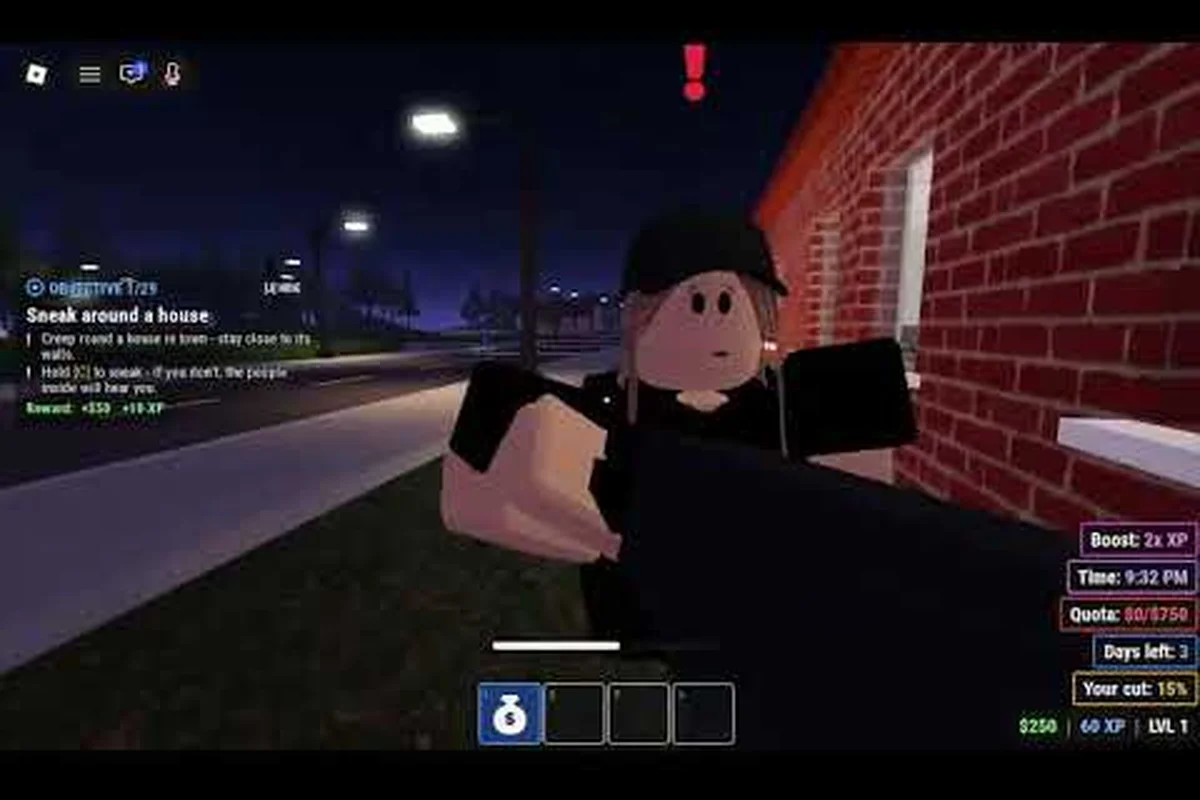
Criminal simulator build news matters because this Alpha is still changing its night-heist systems. The latest signals point to a clearer path ahead, while new player totals and recent fixes show which parts of the experience are settling into place.
Criminal Simulator Build News at a Glance
Criminal Simulator is an Alpha night-heist experience on Roblox from Pigged Out Studios. Its official page describes a loop built around robbing the city at night, sneaking past residents, avoiding police and K9 dogs, and selling stolen goods before a deadline. Crews can contain one to four players, which makes every build change relevant to both solo runs and cooperative plans.
As of October 31, 2026, the official Criminal Simulator game page reports more than 5.4 million visits, 92,500 favorites, and 24,800 concurrent players. The page was created on October 8, 2026 and last updated on October 29, giving players a fairly short but measurable window in which to judge development momentum.
Those figures do not prove that every system is finished. They do show that the project has moved beyond a tiny experimental audience and entered a phase where balance, clarity, and technical reliability matter to a much larger group of Roblox players.
| Verified signal | Current reading | What it indicates |
|---|---|---|
| Project stage | Alpha | Major systems may still be revised |
| Visits | 5.4M+ | Strong awareness and early interest |
| Favorites | 92.5K+ | A sizable saved-player audience |
| Concurrent players | 24.8K | Active interest beyond a small test group |
| Official page updated | October 29, 2026 | Recent information was posted shortly before this review |
| Crew size | 1–4 players | Solo and cooperative play are both supported |
What the Current Build Confirms
The current official description confirms several enduring systems that players can use as a stable foundation. A run revolves around choosing targets, gathering loot, remaining undetected, reaching a sale point, and completing the job before the payment deadline expires. The risk of failure is not limited to an arrest; missing the required payment can also expose the crew to the sniper mechanic.
This foundation makes recent Criminal Simulator updates easier to evaluate because a familiar target-to-sale sequence provides a baseline for every patch. For example, if a hotfix reduces detection speed, the same guarded cash pickup can show whether that change creates more breathing room; if carrying limits rise, a loot-heavy run can reveal whether the extra load still fits the crew’s capacity. Likewise, changes to dog behavior, payment timing, or the selling process can be tested against the same route and deadline, separating meaningful balance adjustments from a fundamentally different game loop.
Why Alpha Status Changes Expectations
Alpha releases are working versions, not permanent specifications. A feature may be expanded, simplified, renamed, or temporarily disabled while the developer learns how players use it. That makes the criminal simulator roadmap more important than any individual balance value, because a promising feature may still be an early experiment.
A useful reading of build news separates three layers: what the official page confirms, what players report experiencing, and what the developer may test later. Confirmed systems deserve concrete planning advice, while community observations should be treated as temporary evidence rather than guaranteed behavior.
New Features and Mechanical Signals in the Latest Criminal Simulator Update
The latest available criminal simulator update information centers on an established Alpha loop rather than a finished expansion. The official game page identifies four connected objectives: city robberies, resident avoidance, police and K9 pressure, and deadline-based selling. For players, this means a build's value depends on how efficiently those systems support a complete night rather than one isolated action.
The official page also confirms that the experience supports one to four players per crew. That flexibility creates several practical build paths, because solo players need faster decisions and clearer escape margins, while groups can divide entry, looting, lookout, and escape duties.
Stable Systems Versus Moving Targets
Not every part of Criminal Simulator requires speculation. The presence of the night-heist loop, deadlines, residents, police, dogs, loot sales, and crew sizes is confirmed by the official listing. The uncertain part is how their tuning will evolve across Alpha builds.
| Confirmed system | Current role | Likely tuning area |
|---|---|---|
| Residents | Threaten stealth during entry and looting | Detection speed and line-of-sight range |
| Police | Escalate after suspicious activity | Patrol density, pursuit length, and spawn timing |
| K9 dogs | Track players during a heist | Tracking distance and recovery speed |
| Loot sales | Convert a completed robbery into cash | Sale timing and travel pressure |
| Payment deadline | Forces urgency across the run | Window length and missed-payment pressure |
| Crew support | Enables one-to-four-player operations | Role clarity and coordination tools |
Community reports are useful for spotting recurring frustration, but they should not override the official game page. A player may describe a difficult dog chase caused by personal route choice, bad timing, or a temporary glitch rather than an intentional balance decision. For broader context, the criminal simulator update guide can help separate confirmed changes from impressions gathered after playing.
The Build's Design Direction
The existing structure suggests that the developer is building around a complete heist arc rather than isolated minigames. Entry pressure comes from residents, the escape phase can add police and dogs, and the final sale converts stealth performance into money. That creates a natural relationship between stealth, route selection, loot capacity, and profit.
It also explains why a small change can have a large effect. Increasing resident detection may reduce the value of slow, cautious looting. Reducing police persistence may make risky targets more attractive. Changing the sale deadline could shift attention from maximum loot to reliable delivery. These ripple effects matter more than whether one numeric value moved by a small amount.
Confirm the Current Build Yourself
Players should test current behavior directly instead of assuming a community clip represents the latest build. Roblox place versions can differ from the version shown in an older video, and restart behavior can affect whether a visual issue is genuinely reproducible.
A short verification routine is useful because a criminal simulator update can change detection, pursuit, and sale timing without announcing every fix. Compare the current Roblox place version with an older clip, then restart the place before judging resident AI, police response, dog tracking, or payment deadlines. This matters because a stale session can preserve old scripts or state, making an apparent criminal simulator glitch look like a new hotfix regression when it is only a cache or version mismatch.
-
Enter a low-risk target and record whether resident behavior matches expectations.
-
Trigger police attention deliberately and note how quickly pursuit begins.
-
Observe whether dogs close distance or lose tracks under the same conditions.
-
Complete a sale and check the payment state against the displayed deadline.
-
Record the exact place version, time, and reproduction steps before reporting a criminal simulator glitch.
That process produces stronger criminal simulator glitch reports than a general claim that the build feels broken. For example, recording whether resident AI enters an escape route immediately, whether police pursuit starts after the expected detection threshold, or whether dog tracking breaks only after a specific obstacle interaction helps maintainers isolate the faulty system. A report that separates animation timing from navigation pathing, detection range, or sale-payment processing is also easier to compare across current place versions and future criminal simulator hotfixes.
Mapping the Alpha Progression Path
The criminal simulator roadmap is currently best understood as an Alpha progression path: stabilize the core heist, improve usability, then expand content and presentation. This interpretation follows from the official description of the game as an Alpha night-heist experience, not because the developer has published a dated feature schedule in the available listing.
That distinction matters. A roadmap based on observed development gives players a framework for interpreting announcements, while a fabricated calendar would create false expectations. The current official evidence supports the stage of development and the designed systems, but it does not establish an exact release date for every planned feature.
Reading the Roadmap in Layers
A practical roadmap separates confirmed foundations, likely expansion areas, and unresolved engineering work. The official page directly supports the core heist loop—robbery, stealth, pursuit, loot, and sale—alongside one-to-four-player crew play and the current Alpha status, while leaving locations, target types, customization options, and release timing unspecified. Those unconfirmed areas should remain flexible until developers publish a dated update, show a playable build, or clarify a milestone, rather than being inferred from isolated Criminal Simulator build news, social posts, or hotfix reports.
| Roadmap layer | Current evidence | Confidence level |
|---|---|---|
| Core heist loop | Robbery, stealth, pursuit, loot, and sale are identified | Confirmed |
| Crew play | One to four players are supported | Confirmed |
| Alpha refinement | Official status remains Alpha | Confirmed |
| Additional locations or target types | Not specified in the available official listing | Unconfirmed |
| Expanded customization | Not specified in the available official listing | Unconfirmed |
| Final release schedule | Not specified in the available official listing | Unconfirmed |
The criminal simulator roadmap overview turns scattered Criminal Simulator update reports into a trackable evidence system: confirmed features such as the robbery-to-sale heist loop and one-to-four-player crew play can be separated from unconfirmed locations, target types, customization, and release timing. This distinction matters because hotfix notes may document Criminal Simulator glitches or a single build change without establishing a planned milestone, so a post should count as roadmap evidence only when it identifies a repeatable development signal, names a concrete content addition, or provides verification through an official announcement or playable demonstration.
What Counts as Meaningful Progress
Meaningful progress is not simply an increase in player count. It can include clearer controls, fewer impossible encounters, clearer deadline feedback, stronger co-op tools, or better balance between targets. These changes improve the core experience even when they do not add a headline feature.
For example, a bug that prevents a player from selling collected loot has a greater effect than a minor visual inconsistency. One damages completion, income, and progression at once. Another may be distracting but manageable. Prioritization should reflect player impact, reproducibility, and how many runs the issue affects.
| Improvement type | Player impact | Easy to verify | Example |
|---|---|---|---|
| Blocking functionality | Very high | Yes | Sale cannot be completed |
| Progression blocker | Very high | Yes | Payment state becomes inconsistent |
| Severe balance issue | High | Usually | Police spawn makes targets impossible |
| Visual confusion | Medium | Yes | Detection indicator appears without a clear source |
| Cosmetic inconsistency | Low | Yes | Minor lighting or interface mismatch |
Judge Announcements Against the Current Build
Future announcements become more useful when evaluated against the current build. Look for explicit changes to crew size, resident detection, K9 behavior, police escalation, loot capacity, sale windows, and payment deadlines. Also note whether a developer labels something as experimental, temporary, or permanently adjusted.
A community video by Blueburry offers a visual guide to weapons, money, and upgrades, but it should be treated as a snapshot rather than official release documentation. Pairing player observations with the official listing and a current in-game check helps prevent old footage from being mistaken for a fresh patch.
Criminal Simulator Glitches and Hotfix Priorities
A criminal simulator glitch can affect the result of a run even when the core design remains unchanged. Examples include stuck movement, inconsistent detection feedback, loot that cannot be collected, unusable sale points, or a deadline that appears to update incorrectly. The important question is not whether something looks unusual, but whether it interrupts the intended sequence consistently.
A criminal simulator hotfix is best judged by the symptom it resolves and whether the correction remains after a fresh session. Restarting the client, rejoining the server, and checking the current place version are simple but important controls. They help determine whether a problem is local, intermittent, or tied to a specific build.
What a Useful Issue Report Contains
Players reporting an issue should minimize guesswork. The useful record includes the current build version, platform, solo or crew status, the target or area, the exact action performed, and what the game displayed afterward. A short sequence of steps is more valuable than a long description with uncertain timing.
| Symptom category | Evidence to record | Priority |
|---|---|---|
| Movement or collision | Location, obstacle, input, repetition rate | High |
| Loot interaction | Item state, pickup prompt, hand capacity | High |
| Sale or payment | Amount, sale location, deadline display | Critical |
| Police or dog behavior | Route, distance, detection source, escape result | Medium |
| Interface display | Expected value, visible value, HUD state | Medium |
| Visual-only issue | Camera angle, lighting, animation | Lower unless persistent |
The criminal simulator development timeline can help connect the current Alpha build to earlier development milestones, while the official page remains the best source for the current stage and supported crew size. For build news, compare the listed version with the date of the last Alpha update: a change in crew capacity may reflect a progression milestone rather than a separate hotfix, whereas a loot pickup, sale, or police-detection change may identify the exact patch where a reported glitch first appeared.
Distinguishing a Glitch From Balance
Not every frustrating event is a glitch. A police response that feels too aggressive may be intentional tuning, especially if it occurs consistently and supports a broader risk system. Conversely, a patrol spawning inside a visible safe area or a sale prompt refusing a completed interaction is more likely to be an implementation problem.
A useful test asks whether the behavior contradicts the game's stated rules. The official description establishes police, dogs, residents, deadlines, and selling, but it does not guarantee specific spawn distances or reaction times. Treat clearly contradictory failures as bug candidates and subjective difficulty changes as balance feedback.
What a Good Hotfix Response Should Show
A useful response identifies the affected behavior, provides a reproduction path, and explains whether a correction has been deployed or queued. If the developer cannot reproduce the report, asking for console output, a clip, or another player's confirmation can narrow the cause.
Community reports can be particularly valuable for issues involving timing or AI. A recurring report from independent crews may indicate a systemic pathfinding or detection problem. A single report may still matter, especially when it blocks selling or payment, but it should be labeled as unconfirmed until reproduced.
Practical Checks for Every Criminal Simulator Update
A criminal simulator update should be evaluated against a repeatable test plan rather than an entire evening of unstructured play. Short, focused sessions expose regressions and make it easier to determine whether a change is intentional. The most valuable checks cover the full route from entry through payment because one broken link can invalidate an otherwise successful robbery.
First-Session Verification
Start with a simple target and use a consistent route. This minimizes confusion and creates a baseline for later comparisons. Verify movement, prompts, loot pickup, carrying behavior, and the transition from the target to the sale point. The test should be completed without relying on a partner who can cover for a mistake.
A good baseline records six points: keep the route and target identical across test runs, then log completion time, visible or audible detection cues, carried-loot count, capacity-state changes, cash credited at the sale point, and remaining-time accuracy. For example, if the same target route takes noticeably longer after a build update, that timing difference can expose pathing or detection changes; comparing loot and cash totals also helps separate pickup failures from sale-processing errors. Repeating this controlled run after each hotfix creates a useful reference for Criminal Simulator update news without confusing build changes with route choice or player mistakes.
-
Entry path: Can the player enter without an obvious collision or blocked doorway?
-
Resident response: Does detection begin only under the expected visible or audible cues?
-
Loot pickup: Does every selected item register in the carried inventory?
-
Capacity state: Does the interface reflect the current carried amount?
-
Sale result: Does the transaction convert loot into cash as displayed?
-
Deadline state: Does the remaining-time indicator remain consistent through the run?
Update Comparison Template
Record results before and after a patch rather than relying on memory. The table below provides a format players can copy for their own tracking. For example, note whether resident detection, police pursuit, dog tracking, loot pickup, sale transaction, or deadline display changed after the hotfix; marking each as unchanged or changed makes update news easier to verify without confusing a patch effect with a different route or crew setup.
| Check | Previous result | New result | Status |
|---|---|---|---|
| Resident detection | Baseline observation | Current observation | Unchanged or changed |
| Police pursuit | Baseline observation | Current observation | Unchanged or changed |
| Dog tracking | Baseline observation | Current observation | Unchanged or changed |
| Loot pickup | Baseline observation | Current observation | Unchanged or changed |
| Sale transaction | Baseline observation | Current observation | Unchanged or changed |
| Deadline display | Baseline observation | Current observation | Unchanged or changed |
This method also helps evaluate Criminal Simulator update news without overstating a change that may have resulted from different player behavior. Keeping the target, crew size, route, loadout, and attempted sequence consistent creates stronger evidence for a build or hotfix effect than switching several variables at once. For example, if the table shows dog tracking as “changed,” repeat the same route and crew setup before reporting a regression; an immediate second sale transaction can reveal whether the patch affected loot pickup, sale transaction timing, or only the deadline display. Record the build number, test time, and whether the result came from a fresh session or an already-running session, because state differences can otherwise be mistaken for an update fix.
Build and Hotfix Reporting Workflow
A concise report should follow this order: what you expected, what happened, how to reproduce it, and whether it blocks progress. Add the place version and relevant clip or screenshot afterward. This structure respects the time of maintainers while making the report easier to search.
When discussing issues, avoid labeling every difficult chase a criminal simulator glitch. Use "reproduced consistently" only after multiple attempts, and separate direct observation from inference. For example, reporting that the sale point does not register a completed transaction is more actionable than claiming the payment system failed without describing the exact sequence.
The criminal simulator build and release overview can provide wider context on how developer updates and version milestones relate to the current Alpha release. Comparing its dated build entries with the active Alpha version can reveal whether a reported criminal simulator glitch appears only after a specific map, vehicle, sale-point, or police-response change, helping separate newly introduced regressions from older Alpha behavior.
Reading Criminal Simulator Updates Without Rumor
Separating reliable criminal simulator update information from rumor requires a simple evidence hierarchy. The official game page comes first because it establishes the current state of the project. Player-created guides and videos come next, but their timestamps and recorded game versions matter. Community discussion is useful for bug frequency and player sentiment, although it should never be presented as an official promise.
This approach also prevents a common mistake: turning every reasonable expectation into confirmed news. A natural feature request for more crew roles does not prove that roles are being added. A visible animation problem may be a known hotfix candidate, but it is not automatically a planned feature.
Evidence Levels for Players and Writers
| Claim type | Acceptable support | How to describe it |
|---|---|---|
| Game stage | Official Roblox page | Confirmed as Alpha |
| Crew range | Official Roblox page | Supports one to four players |
| Current player count | Official Roblox page at access time | Snapshot as of October 31, 2026 |
| Reproducible bug | Repeated player test and current build information | Confirmed by the reporter, awaiting maintainer response |
| Difficulty change | Consistent comparisons across similar runs | Balance shift observed by community testing |
| Future feature | Official announcement only | Unconfirmed until announced |
The official page listed 24.8K concurrent players and 5.4M+ visits at the time of verification. Those are snapshots, not promises that the numbers will remain constant. Articles should always pair them with an as-of date and avoid turning traffic into a proxy for quality or completion.
The Best Evidence to Follow
The strongest continuing signals are changes in the official description, updates to the Roblox place, visible version notes, developer posts, and repeatable player tests. These sources reveal both intent and implementation. The official listing confirms the night-heist structure and Alpha status, while version notes and direct testing reveal whether the experience is becoming more stable.
Players can also use community guides for practical orientation. NoobBlox's guide covers money, methods, and general tips, but its use of the word "codes" in the title does not prove that a functioning code system exists. That distinction matters when evaluating update coverage and preventing unsupported claims from spreading.
Frequently Asked Questions
What does the latest Criminal Simulator build add?
The latest verified information confirms an Alpha experience centered on night robberies, resident avoidance, police and K9 pressure, loot sales, and payment deadlines. It also confirms one-to-four-player crew support. The available official listing does not provide a complete dated changelog for every feature added during development, so players should separate confirmed systems from future possibilities.
How can I tell whether a Criminal Simulator hotfix fixed an issue?
Reperform the original reproduction steps on the current build after restarting Roblox and joining a fresh server. Record the place version and compare movement, interaction, sale, or pursuit behavior with the earlier attempt. If the issue persists, provide the exact steps, expected result, actual result, and a clip so the report distinguishes a recurring defect from an isolated interruption.
Which Criminal Simulator glitches should receive the highest priority?
Priority should follow player impact. Problems that prevent loot pickup, selling, payment processing, or mission completion come first because they block the entire progression loop. Detection, pursuit, or dog problems follow when they repeatedly make a target unusable. Cosmetic issues matter, but they should generally sit below functional failures when maintainers prioritize limited development time.
Does the Criminal Simulator roadmap confirm a full-release date?
No exact full-release date appears in the official information available for this article. The project remains identified as an Alpha, which supports ongoing refinement but not a guaranteed schedule. Players should treat dated claims as provisional unless Pigged Out Studios announces them through an official channel, and should expect the roadmap to evolve as the development process continues.
How should players report a Criminal Simulator glitch effectively?
Include the current place version, platform, solo or crew status, location, exact actions, expected behavior, actual behavior, and reproduction rate. Add a clip or screenshot when safe and avoid posting unsupported accusations. Clear evidence is especially valuable when it distinguishes a consistent defect from an ordinary chase, difficult route, or temporary network interruption.