
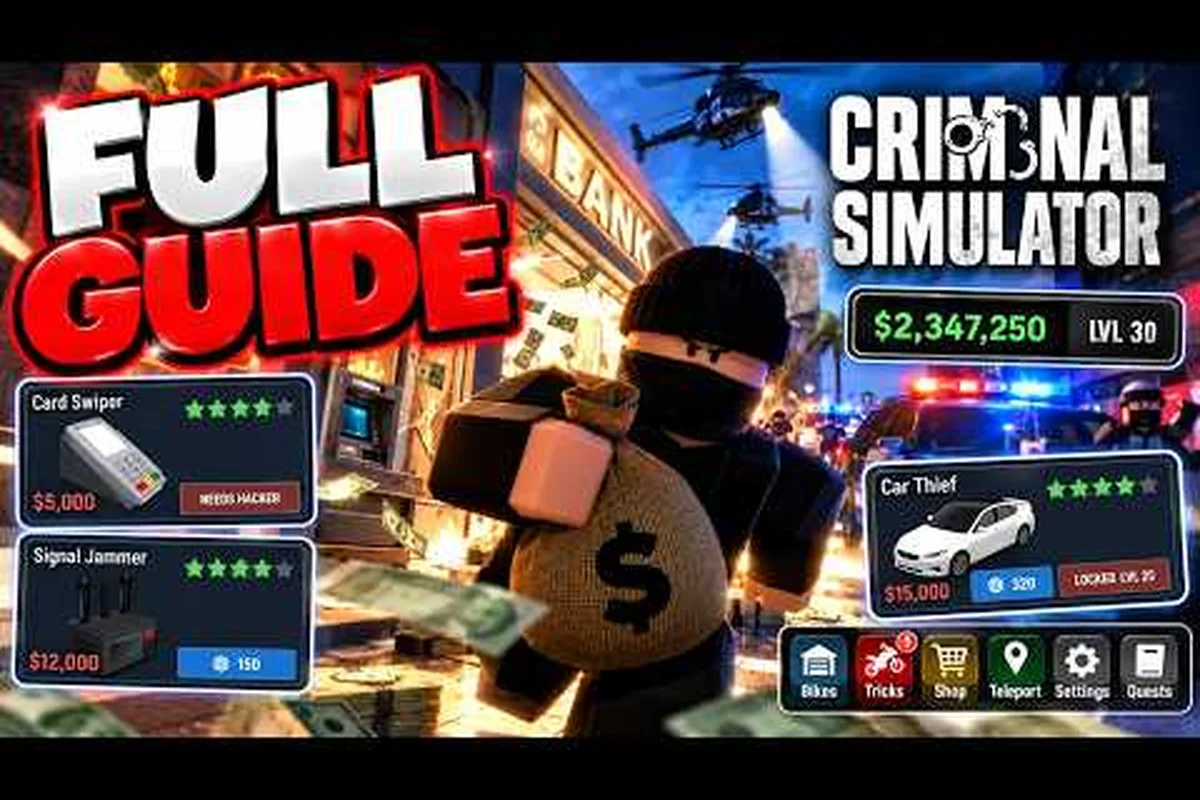
Criminal simulator money decides whether your next run grows or stalls. This guide shows where to cash out, clear debt, and invest in upgrades without wasting payouts.
Criminal Simulator Money Starts With a Clear Financial Plan
Criminal simulator money is the central resource behind every successful night, and managing it well can determine whether you keep progressing or spend every payout on the wrong item. The official Criminal Simulator Roblox game page describes a night-heist loop built around stealing, escaping residents and police, selling loot before the deadline, and paying off debt. That deadline makes every purchase a trade-off between immediate security and stronger future earnings.
The best approach is to treat each robbery as a business cycle: earn cash, settle urgent obligations, preserve a reserve, and then invest in equipment that raises your earning potential. This guide explains where the money goes, how to prioritize criminal simulator upgrades, and when saving is smarter than spending.
The Core Financial Loop
Every productive cycle contains four stages, and each one changes the value of your Criminal Simulator money: preparation spends cash on equipment that should reduce failure risk, the robbery generates gross earnings, escape determines whether that payout survives, and settlement converts loot into spendable cash after debts are handled. For example, a player who buys stronger weapons but skips route planning may still lose the haul to residents, police, or K9 units; treating debt as part of the cycle can also prevent a successful rob from becoming only a temporary cash increase. This makes upgrades and equipment purchases useful only when they support a complete earning cycle rather than replacing it.
| Stage | Main action | Financial purpose |
|---|---|---|
| Prepare | Select targets, route, and required gear | Reduce failure risk before committing |
| Rob | Collect cash and valuables | Build gross earnings |
| Escape | Avoid residents, police, and K9 units | Preserve the full payout |
| Settle | Sell loot and pay debts | Convert activity into usable cash |
The order matters. Buying expensive equipment without a reliable route can turn a planned heist into a loss. Likewise, ignoring debt can consume nearly every payout. Players beginning with the basic earning loop can review what Criminal Simulator money is used for to connect each purchase with a specific progression need.
Earning Criminal Simulator Cash Safely and Efficiently
The official game page confirms that crews can include one to four players, while the shared loop revolves around gathering loot, evading pursuit, and selling before time expires. This creates two earnings levers: the value collected during a night and the percentage that reaches your account after debts, losses, and purchases.
Solo players can simplify planning by choosing one dependable route before attempting anything ambitious. Crews may divide responsibilities, but only if each member knows the escape point, sale point, and deadline. A clear crew plan reduces wasted rounds and makes criminal simulator cash more predictable.
Planning the Night Before Starting
A profitable night begins with a budget rather than a wish list. Estimate what you can realistically collect, subtract existing obligations, and decide how much of the remainder should become equipment. This prevents the common mistake of treating every available dollar as spendable immediately.
| Planning factor | Conservative approach | Aggressive approach |
|---|---|---|
| Target selection | Familiar locations with a clear exit | Multiple valuable targets |
| Crew size | Solo or one reliable partner | Full four-player crew |
| Spending | Essential gear only | Several upgrades before the night |
| Reserve | Keep enough for debt and recovery | Spend nearly all available cash |
| Main risk | Slower progression | A failed heist becomes expensive |
Community guides such as Blueburry’s Criminal Simulator guide covering weapons, money, and upgrades can help new players compare early purchases. Treat that video as community guidance rather than an official developer source, because update timing and exact prices may vary by version.
Protect the Payout
A successful theft only produces profit after a clean escape and sale. Avoid unnecessary detours, unnecessary fights, and risky interactions with police or K9 units. If the deadline is approaching, a completed escape is worth more than one additional item.
Criminal simulator debt also changes the calculation. Suppose a run produces 10,000 in gross value, but 6,000 must go toward outstanding debt. Spending the entire 10,000 would leave the account empty and turn the next attempt into a recovery mission. A better rule is to treat debt repayment as the first claim on new criminal simulator cash, then assign a smaller share to upgrades.
A Practical Nightly Routine
Use this sequence to turn each Criminal Simulator run into a repeatable money-making process: record the cash earned, loot value, time spent, and any debt payment from every heist, then compare those figures after each session. For example, a run that yields $12,000 but requires three weapon reloads and two extra escape attempts may be less profitable than a faster $9,000 route. This method helps identify which loot sources, equipment choices, and Criminal Simulator upgrade costs actually improve cash flow, while keeping debt obligations and available Criminal Simulator cash visible.
-
Check obligations. Review the debt due and the amount of cash available.
-
Set a spending cap. Choose one upgrade, or a defined cash reserve, before entering a heist.
-
Choose a safe route. Favor targets and escape paths you understand instead of chasing maximum loot.
-
Collect efficiently. Move directly between loot sources and leave once the route is complete.
-
Escape as a unit. A captured teammate can spoil the shared payout.
-
Sell promptly. Convert loot into cash before continuing, especially when the deadline is close.
-
Allocate proceeds. Pay required debt first, buy only the highest-value upgrade, and retain the remainder.
For repeatable routes and cash flow, the Criminal Simulator money grinding guide offers a useful way to compare efficiency across several runs rather than judging a heist by loot value alone. Track total Criminal Simulator cash, loot value, time spent, weapon reloads, failed escapes, and debt payments separately, then calculate profit per minute. A $12,000 payout that costs 18 minutes and forces two extra escape attempts may be less efficient than a $9,000 route completed in 10 minutes with one reload. This comparison also reveals whether Criminal Simulator equipment or upgrade purchases reduce downtime enough to improve long-term earnings.
Managing Criminal Simulator Debt Without Missing Deadlines
Debt is a priority because the official game page says failed debt payments put the player at risk from a sniper. That consequence makes debt management more than a simple savings preference. It affects survival and can prevent players from taking risks needed to earn more cash later.
Debt should be paid according to the deadline displayed in the game, not merely when the balance looks large. A small balance may need attention sooner than a larger one with more time remaining. Treat the displayed due date as the real schedule.
Debt-Payment Options
| Option | Best use | Advantage | Main risk |
|---|---|---|---|
| Full payment | Clearing a balance quickly | Removes the deadline and restores freedom | Leaves little emergency cash |
| Partial payment | Reducing a near-term balance | Preserves some operating money | The remaining balance still carries risk |
| Scheduled payment | Spreading a larger balance across several runs | Creates a predictable cash-flow plan | Delays complete freedom |
| Save for one major payoff | When upgrades can produce a strong return | May reduce total interest or pressure | One failed run can disrupt the plan |
The best choice depends on income stability. If reliable runs regularly produce enough, full payment is usually cleanest. If income varies, reserve enough to continue earning before committing every available dollar. This prevents a debt payment from creating a second problem: being underfunded for the next heist.
Keep an Emergency Buffer
Even when debt is manageable, keep a small buffer in criminal simulator cash for unexpected setbacks. The buffer does not need to cover every possible loss, but it should provide enough operating room to complete another run and rebuild cash flow. A practical rule is to preserve the amount required for the next planned heist and basic recovery purchases.
Debt management and profitable routes reinforce each other. Players who want a deeper look at balancing payouts against obligations can use the profitable nights strategy guide to evaluate how much income a route must generate before spending.
Upgrade Only When It Improves Future Earnings
Upgrades are investments only when they improve future earnings or reduce the likelihood of losing them. Criminal simulator upgrades should be judged by payback: how quickly the item helps you complete a more valuable or safer run compared with keeping the cash.
A costly item that you rarely use may be less useful than a modest upgrade available for every run. Before purchasing, identify the bottleneck: weak tools, insufficient capacity, poor escape performance, or a need for faster completion. For example, if Criminal Simulator equipment purchases frequently prevent a clean getaway, prioritize escape speed or heat reduction over a premium weapon that only increases payout on successful heists; if tools are adequate but bags limit your haul, upgrade capacity first. Comparing expected Criminal Simulator cash earned per minute, rather than the item’s sticker price, shows whether the upgrade pays back before the next purchase becomes necessary.
Upgrade Categories and Their Value
| Upgrade category | What it improves | Best purchase moment |
|---|---|---|
| Weapon | Reliability and control during confrontations | When ordinary tools repeatedly fail |
| Equipment | Carry capacity, utility, or mission capability | When routes are completed but value is left behind |
| Storage | Holding more loot between collection and sale | When you regularly run out of space |
| Movement or utility | Faster traversal and smoother escapes | When time is the main cause of failure |
| Crew capability | Better coordination and role support | After the solo route is reliable |
Exact inventory names and prices may change as the Alpha develops, so compare the current shop rather than relying on an old setup. The official game page identifies the experience as an Alpha night-heist game; balance changes are therefore plausible.
The Value of Fewer, Better Purchases
Buying one item at a time makes it easier to measure its impact. Track the result over several runs, comparing successful escapes, time used, loot collected, and criminal simulator cash left after debt. If performance improves consistently, the upgrade is paying for itself. If results barely change, another purchase may offer more value.
Players who want a detailed shopping hierarchy can compare options in the Criminal Simulator upgrade selection guide. The useful comparison is not simply “expensive versus cheap,” but “useful every night versus useful in one situation.”
Choosing Criminal Simulator Weapons and Equipment
Criminal simulator weapons and criminal simulator equipment serve different purposes, so the strongest loadout is not automatically the one with the highest weapon price. Gear should support a complete route: collect enough value, survive pressure, move efficiently, and escape before the clock expires.
Weapons Versus Utility Equipment
| Option | Primary value | Ideal use | Buying principle |
|---|---|---|---|
| Basic weapon | Handling routine threats | Early and predictable routes | Buy only when the current tool is unreliable |
| Stronger weapon | Better performance against difficult opponents | High-risk targets or frequent pursuits | Upgrade after a normal weapon becomes the bottleneck |
| Carry equipment | Increasing what can be brought home | Longer or more valuable routes | Buy when capacity limits actual profit |
| Movement equipment | Reducing travel time | Routes near the deadline | Buy when time loss creates missed value |
| Escape equipment | Improving the odds after contact | Patrol-heavy areas | Buy when repeated escapes fail |
Do not buy a weapon simply because it appears stronger in a list. Consider the frequency of use, the route’s difficulty, and how the purchase changes the final sale amount. A weapon used once every several nights may deliver a poorer return than equipment that makes every collection run more productive.
Build a Balanced Loadout
A balanced setup usually includes a reliable weapon, enough carrying capacity for the planned route, and one utility item that solves a recurring problem. Add further criminal simulator equipment only when performance data shows a clear weakness. This prevents inventory clutter and preserves cash for later investments.
Before buying, ask three questions: does the equipment solve a recent failed run, will you use it on the next several runs, and can it improve loot, speed, or survival without creating criminal simulator debt? For example, a faster weapon may earn more cash per successful run, but its purchase price and upkeep must be weighed against the extra criminal simulator cash it returns; otherwise, save that cash for a larger carrying-capacity upgrade.
| Question | Yes answer | No answer |
|---|---|---|
| Does this item solve a recent failure? | Buy after checking its price and upkeep | Keep saving |
| Will it be used on the next several runs? | Treat it as a priority purchase | Consider a cheaper option |
| Does it improve loot, speed, or survival? | It may improve future cash flow | Save the cash instead |
Community reporting is particularly useful for real-world use patterns, but it should be checked against the current game version. NoobBlox’s Criminal Simulator economy and money tips video is one community resource for comparing early methods; it is not an official guide or a verified source of current pricing.
A Repeatable Criminal Simulator Money Strategy
The strongest strategy is a repeatable budget that separates survival, debt, equipment, and profit. Players who only watch their current balance often feel rich after one payout and poor after the next purchase. Tracking the flow between categories makes every decision easier.
Weekly Cash-Flow Review
After every few runs, review four numbers using the same cutoff period and note the starting balance beside them; this exposes whether criminal simulator cash is actually accumulating instead of merely circulating. For example, if gross loot rises from $10,000 to $12,000 but net cash falls from $7,500 to $6,000 after failed escapes, equipment losses, and debt interest, the apparent revenue gain is not improving financial position. Comparing the period’s total with prior runs also shows whether debt payment is reducing balances on schedule and whether equipment purchases create measurable gains in later runs rather than tying up cash without improving results.
-
Gross value collected before deductions or losses.
-
Net criminal simulator cash received after failed or sold loot is accounted for.
-
Debt paid during the period.
-
Equipment purchased and whether it improved later results.
| Metric | Useful question | Desired pattern |
|---|---|---|
| Gross value | Are routes producing enough before setbacks? | Stable or rising |
| Net cash | Are escapes and sales preserving earnings? | Close to gross value |
| Debt payment | Is the balance moving toward zero on time? | Consistent reduction |
| Upgrade impact | Are purchases improving performance? | Measurable benefit |
For example, if ten runs generate $120,000 in gross loot but failed escapes and equipment losses leave only $18,000 in criminal simulator cash, activity is not producing financial progress. Three stronger runs that preserve $45,000, pay down $30,000 of criminal simulator debt, and fund weapons or equipment that improve escape success are more valuable because they change the balance and reduce future risk.
Decisions for Common Financial Situations
| Situation | Best decision | Why |
|---|---|---|
| Low cash and high debt | Run a familiar route, pay debt, avoid luxury upgrades | Restores operating room |
| High cash and low debt | Save or buy one high-impact upgrade | Prevents wasteful spending |
| Frequent failed escapes | Upgrade movement or escape capability | Reduces recurring losses |
| Poor carrying capacity | Invest in storage or carry equipment | Converts route time into more value |
| Weapon struggles | Compare a stronger weapon with utility gear | Fixes the actual bottleneck |
| Crew performs well | Maintain the route before changing purchases | Protects a proven income source |
The central rule is simple: spend on bottlenecks, not appearances. A successful route that still leaves loot behind means your current setup is failing to convert risk into Criminal Simulator cash; a stronger weapon may improve the encounter but will not recover that missed income. Track each run’s gross loot, purchase costs, and pursuit losses, then compare them with debt payments and available Criminal Simulator upgrades. If repeated pursuits erase profits, prioritize movement or escape capability so more completed jobs become net-positive instead of adding another expensive gun without improving cash flow.
Turning Surplus Cash Into Long-Term Progress
Once debt is controlled and the current setup performs reliably, excess criminal simulator money can fund a second growth cycle. This may mean upgrading equipment, supporting a crew, or accumulating a reserve for a difficult but lucrative route. The best choice depends on whether the player wants faster progression now or more stability later.
A useful framework separates criminal simulator money into four cash buckets, each tied to a different expense: scheduled debt payments, routine heists, equipment upgrades, and high-value opportunities. For example, if a weapons upgrade improves survival on a difficult route, classify its cost as an upgrade purchase rather than draining the operating fund; if cash is needed for required debt payments, protect that amount before considering optional gear. This allocation lets criminal simulator cash support immediate criminal simulator debt obligations while still funding long-term criminal simulator upgrades and future expansion.
| Cash bucket | Purpose | When to use it |
|---|---|---|
| Debt fund | Required payments | Before optional purchases |
| Operating fund | Normal heists and recovery | Always keep available |
| Upgrade fund | A planned equipment purchase | After identifying a bottleneck |
| Opportunity fund | Routes, rare opportunities, or future expansion | Only when the core plan is secure |
Do not spend the operating fund just because the shop has a discount. Discounts are valuable only when the item solves a live problem. Similarly, holding every dollar indefinitely does not create progress; cash has a purpose when it converts into better survival, higher loot value, or faster completion.
When to Save and When to Spend
Save when the next upgrade lacks a clear use, a reliable route is not yet established, or debt needs attention. Spend when the current equipment repeatedly causes loss, a route has measurable room for improvement, and the purchase can be tested over several runs.
This approach makes criminal simulator cash more than a score displayed after a robbery. It becomes working capital. The best financial state is not having the largest balance at one moment; it is having enough income and equipment to clear obligations while continuing to improve.
The Complete Financial Priority Order
Use this sequence whenever you are uncertain about a purchase: compare the item’s price with the cash generated by your current routes, then ask whether the upgrade improves survival, removes a recurring penalty, or increases each run’s payout. For example, replacing unreliable criminal simulator equipment may prevent failed jobs, while buying stronger criminal simulator weapons can raise success rates but also consume funds that would otherwise cover criminal simulator debt.
-
Meet the immediate debt deadline.
-
Preserve enough cash to complete another run.
-
Fix equipment that repeatedly causes failure.
-
Increase the value of successful routes.
-
Save for a larger long-term upgrade.
The order protects the player from common criminal simulator money mistakes: empty accounts, missed debt deadlines, expensive dead-end criminal simulator gear, and unnecessary grinding. For example, if a criminal simulator weapon upgrade increases the payout of a route but still leaves too little cash to cover the next criminal simulator debt payment, the safer choice is the equipment repair that preserves run capacity. The key test is expected cash flow: subtract recurring criminal simulator expenses from the extra income the upgrade creates, then decide whether that gain justifies its purchase price and can be repeated without returning the account to zero.
Frequently Asked Questions
What is the best way to earn criminal simulator money?
The best approach is to repeat a familiar, reliable route, escape before the deadline, and sell every item you collect. Consistent small profits are more useful than repeatedly risking cash on an ambitious route. Once the basic route is stable, improve the equipment that limits its loot value, escape speed, or survival.
Should all criminal simulator cash go toward paying criminal simulator debt?
Not always. Pay enough to meet the nearest required deadline, then keep enough cash to complete another heist. If reliable runs produce enough, clearing the debt sooner may be preferable; otherwise, a scheduled payment protects your ability to keep earning without missing the due date.
What upgrade should I buy first in Criminal Simulator?
Buy the upgrade that solves your most frequent failure. If you run out of carrying space, improve capacity; if patrols cause repeated losses, prioritize escape or movement improvements; if your current weapon cannot handle normal threats, compare stronger weapons. Measure results over several runs before making another purchase.
Are the most expensive criminal simulator weapons always worthwhile?
No. A higher price does not guarantee a better return. The best weapon depends on route difficulty, how often you use it, and whether it prevents losses worth more than its cost. Compare criminal simulator equipment by practical impact rather than by price alone.
Should I buy equipment immediately after one successful robbery?
Usually not. One payout is not enough evidence to identify the right investment. Run the route several times, record whether loot, escape time, or survival improves, and buy only when the result confirms a meaningful benefit. This prevents a single lucky night from causing an expensive mistake.